The Paintings of Philip T. Gilchrist R.B.A.
A life in Colour
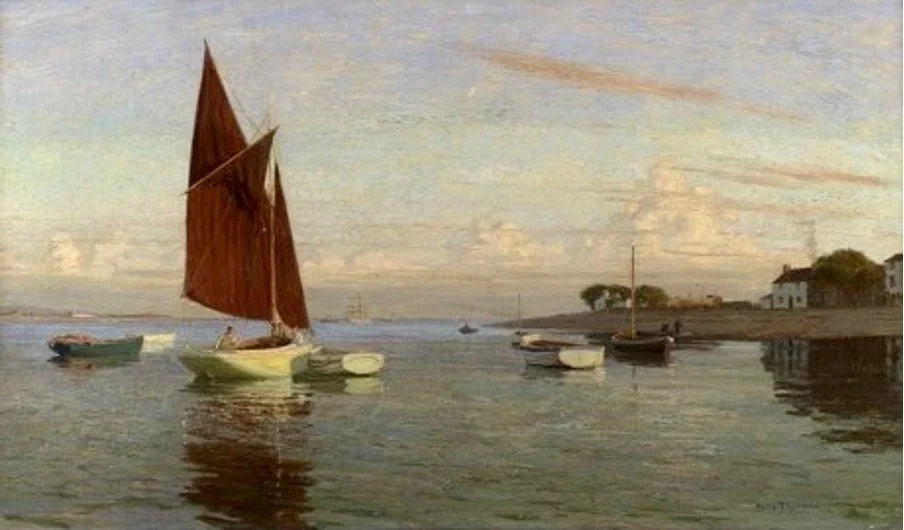
“Back to the Moorings”, 1907, shown at the Royal Academy in 1909.
This introduces the gallery of paintings by Philip T. Gilchrist R.B.A., published today on the website. In the early years of the twentieth century, he was a highly admired and nationally respected marine artist. Philip lived at Sunderland Point for over forty years. Before that, he had been a regular summer visitor with his family.
He kept a comprehensive and dated record of his paintings. They start in 1900 and include records of earlier works, ending in the early 1950s. Out of the 250 paintings, the majority date before 1910.
The gallery features images from public collections, auctions, or those owned by family and friends. Also, it includes several works that are yet to be named and dated, as well as black-and-white photographs of some of his key paintings, with the hope of replacing them with authentic copies in the future.
The gallery is divided into groups of paintings in date order.
Early Inspiration
It’s easy to imagine that, as a boy spending summer holidays in the village, Philip was inspired by the sailing ships passing up and down in the Lune estuary.
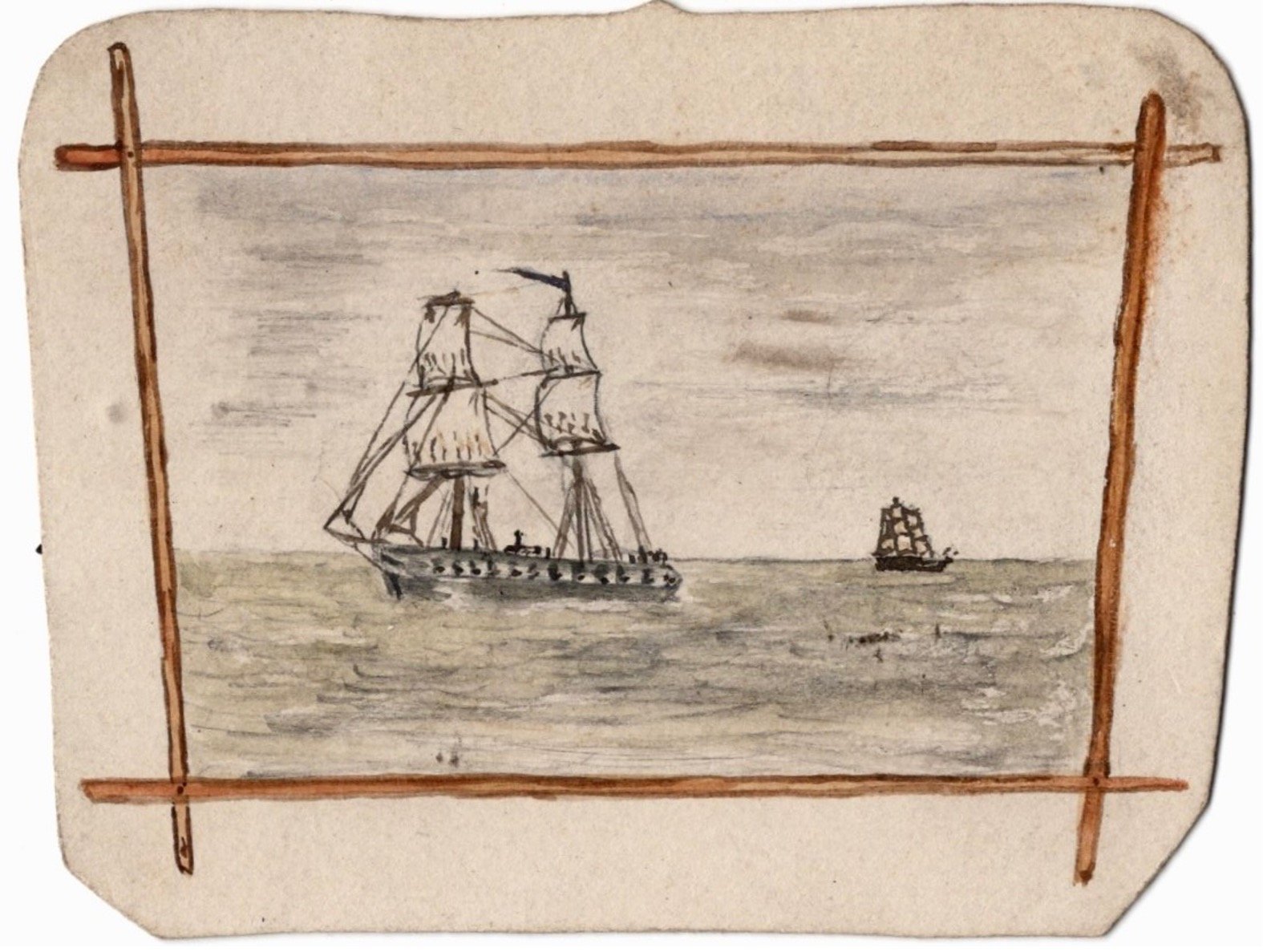
Philip’s first known picture was sketched in 1879, aged 14.
His first paintings that we have seen depict the village. Philip will go on to paint, mostly in oils, the Niagara Falls, railway trains in Wales, temples in Egypt, and Amazonian dolphins, but he always returns to scenes around Sunderland Point.
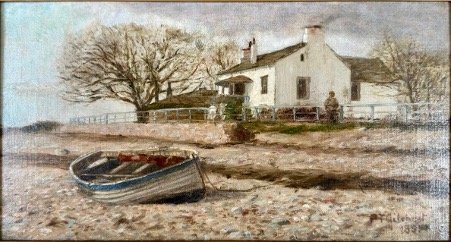
A well-crafted painting of a boat and the Old Hall, dated 1891. Philip would be 26: In a private collection.
Time and place
In the 1890s, before mass photography, visiting an art gallery was immensely popular. Late Victorian exhibitions mainly featured portraits and landscapes; maritime art, and ships at sea, reflecting British overseas trade and naval strength, were highly admired.
Philip was raised in this tradition. Under the guidance of the highly skilled artist Tom Mostyn and in classes at the Manchester Fine Arts Society, he was also influenced by modern trends, primarily from France, especially natural realism, which sought to depict scenes as they occur naturally. What made Philip distinctive was his exceptional talent for colour.
An early appearance in the newspapers was in 1889, at the Manchester Graphic Club’s annual exhibition. His “Head of the Loch” was regarded as “one of the best pictures in the show.”
Later, the Manchester Courier wrote. ‘For three years, he has been a pupil of Mr T Mostyn and has done much in company with his teacher. He has not allowed himself to become a mere copyist but has been imbued with a determination to express his pictures with originality and his own individual feeling.’
However, Philip had not yet found ‘his voice’, as seen in these two paintings, where his subjects and composition reflect the typical style of the period.
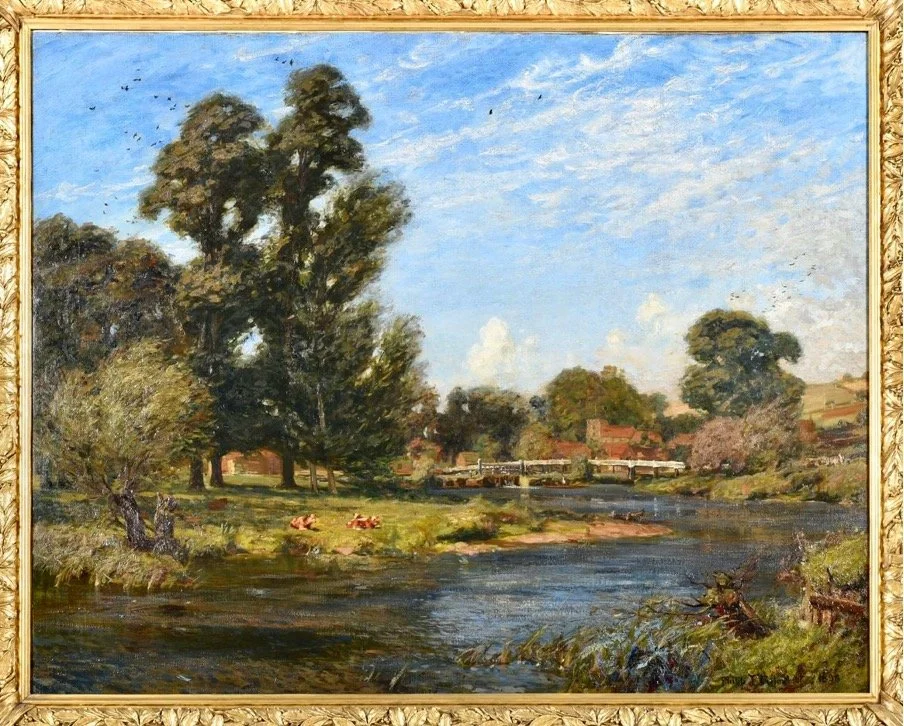
“Streatley-on-Thames” 1899: In a private collection.
His ‘Streatley-on-Thames’ was much admired in Manchester and was prominently placed when exhibited, but some considered it uninspired. The colour is lovely, but ‘the composition is dull and lacks depth’.
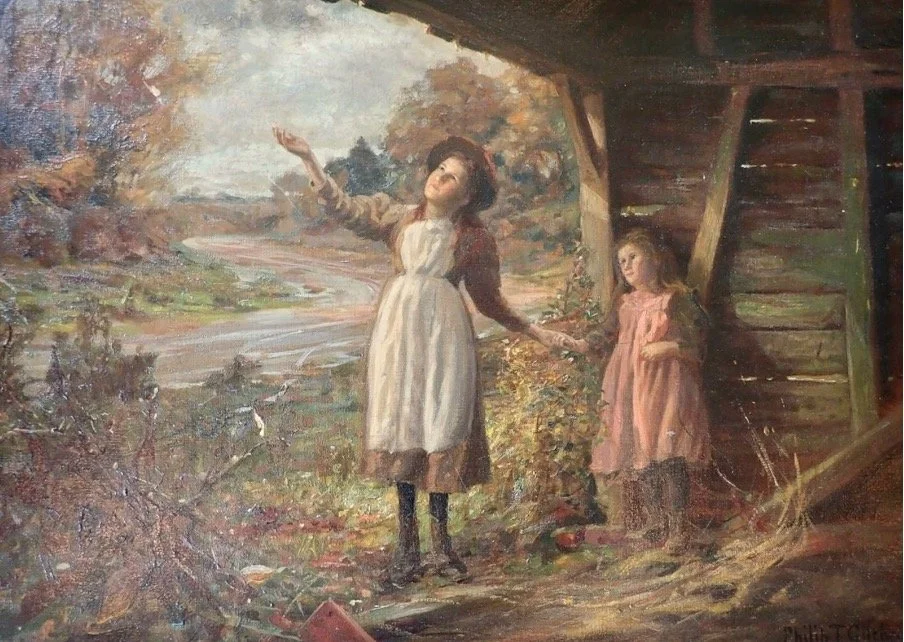
“Clearing up” 1899: In private collection.
In this charming narrative picture, Philip shows versatility. A critic wrote, ‘His ‘Clearing up’ is a very pleasant picture showing two little girls who, after sheltering from a shower under a shed, are anxious to see if the rain is over. In this picture, there is evidence of careful composition and real pictorial feeling. (Manchester Evening News)
However, there were reservations: the elder girl’s arms are slightly too long, and the younger one has a doll-like face.
Figures do appear in subsequent works – sometimes to great effect – but are generally set in the background, its landscapes, and ships at sea that predominate.
In the exhibitions at his own studio in Manchester in 1900 and 1901, one painting stood out.
“An Iron Barque” was his first major success as a marine painter and was accepted by the Royal Academy for the Summer Exhibition of 1901.
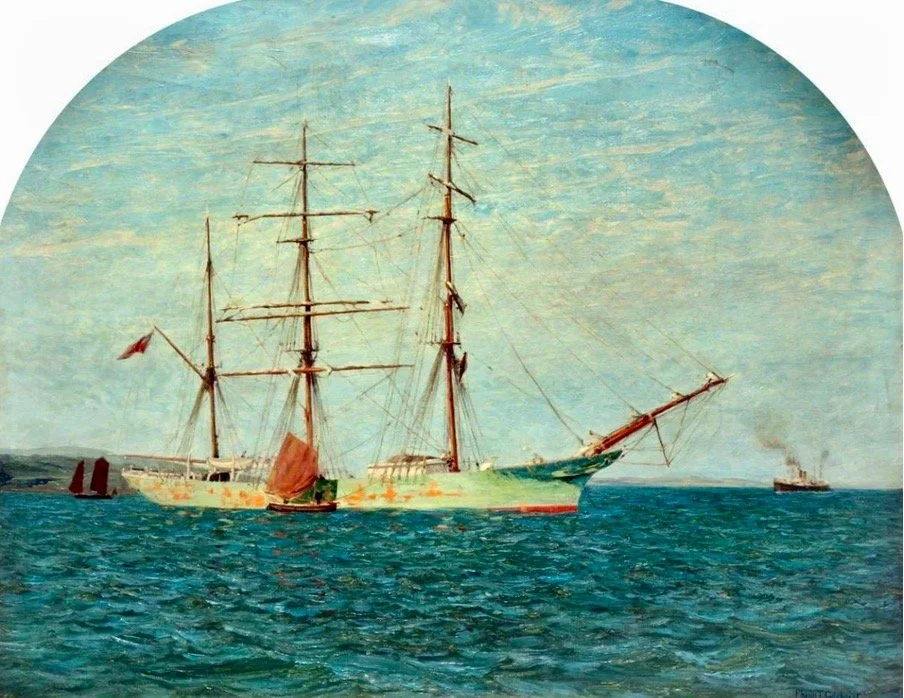
“An Iron Barque” 1901. In the collection of the Walker Art Gallery, Liverpool.
Into his stride
It set the pattern for subsequent paintings. The boat is technically accurate in its dimensions and rigging. The colouring is imaginative, with the blues and greens of the sky and sea blending seamlessly, while the reds in the sail and rust create tension and interest. The colour enhances the natural imagery. Critics recognised this:
“The best is ‘An Iron Barque’, a grass-green vessel, bark-rigged, with all her canvas filled, lying at anchor on an oily bottle-green sea, with a lighter alongside. There is an atmosphere in the streaky evening sky and on the face of the water, which is unmistakably wet. We have a notion that Mr Gilchrist will develop into a colourist. (Manchester City News)
Again, dissenters were criticising his modernist use of colour.
‘“An Iron Barque”, an ambitious work of some power, but marred by a curious colour scheme of Blues and greens.’
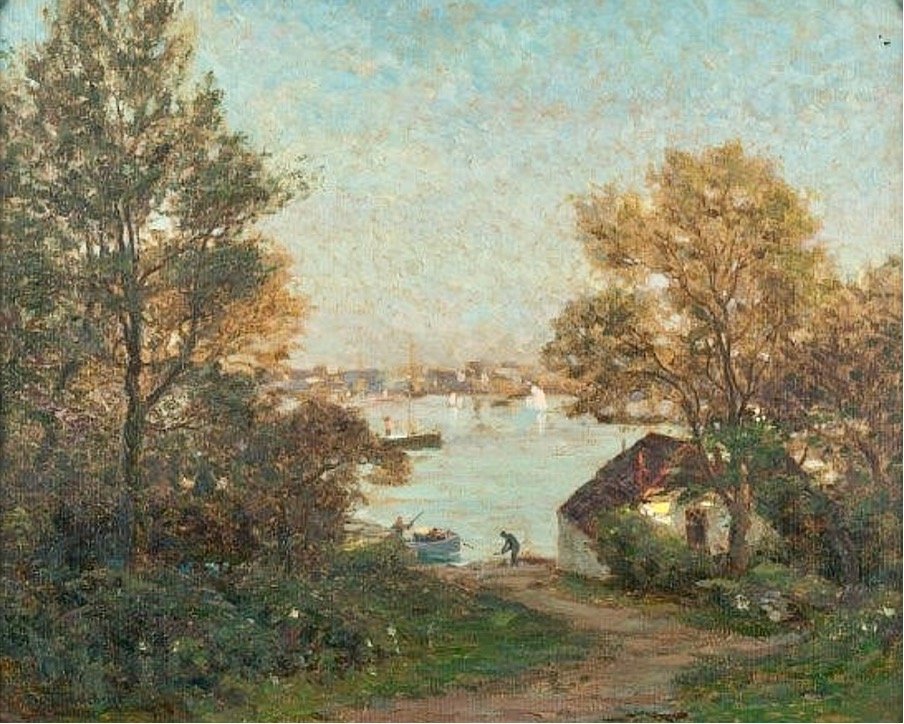
“An Evening in Falmouth” Exhibited at the R.A. in 1902: In a private collection.
In this landscape, a product of his tour of Cornwall, Philip shows maturity in his skilful and imaginative use of colour. The evening sunlight catches the trees, confirming the time of day.
In the early 1900s, Philip travelled around the Mediterranean. His stay in Greece inspired “The Fishers of Phaleron”, a significant advance in his naturalist painting that attracted considerable attention when shown in Manchester, Liverpool, and Birmingham, and at the Royal Academy in the summer of 1903.
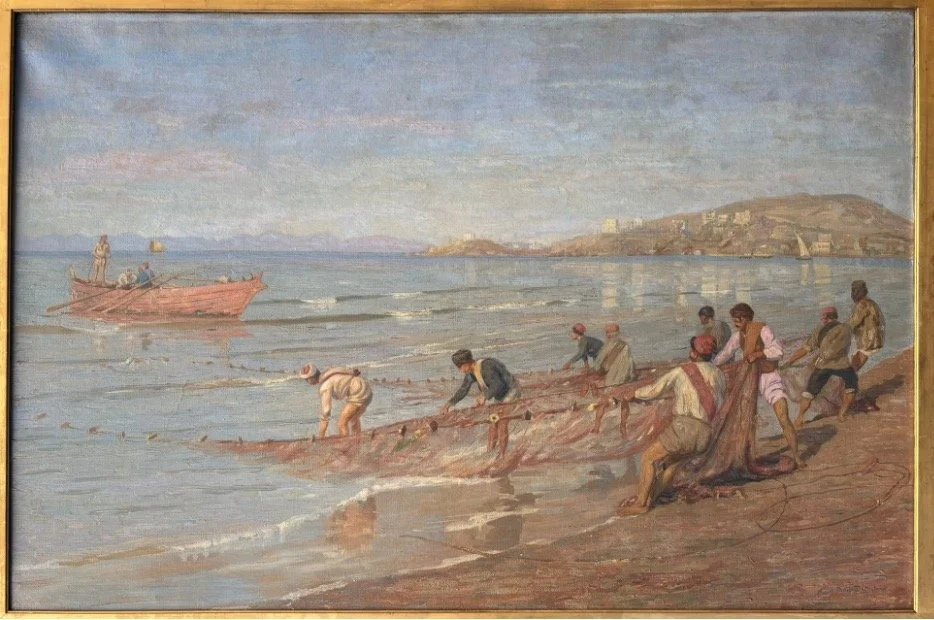
“The Fishers of Phaleron” c1903: In a private collection.
This painting captures, with convincing realism, the movement of the fishermen as they pull on the net, bringing it to shore.
“Mr Philip T Gilchrist makes considerable headway in his work and is fond of the bright side of nature. His picture “Fishers of Phaleron” shows that the artist has revelled in the pure atmosphere of foreign climes, which, combined with the costume appropriate thereto, has enabled him to produce a picture full of good colour and interesting human movement.
It makes one believe that Mr Gilchrist will go far” (Manchester Courier, January 1903).
Philip makes rapid progress, and by 1905, he reaches the height of his artistic power. He takes over the entire Atkinson Gallery in Southport to show 83 of his paintings. Included are his two most famous pictures.
They are marine scenes, but remarkably different.
“Xerxes burning Athens: Flight of the Athenians” is Philip's most ambitious, complex, and detailed composition.
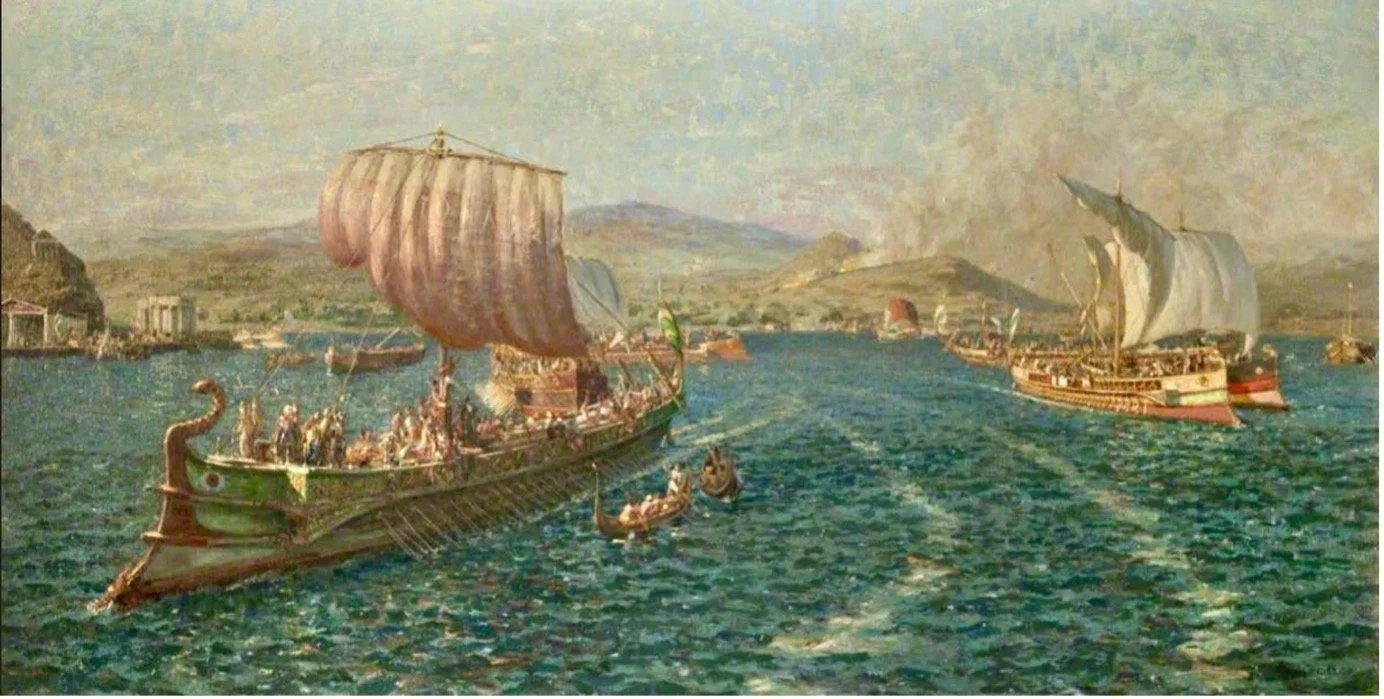
“Xerxes burning Athens: Flight of the Athenians” 1903 In the Collection of Lancaster City Museums.
This is the CGI of the time, a depiction of a historic event brought to life. It shows the evacuation of the Athenians in 480 BCE as the Persians, led by Xerxes, attack the city. The wind in the sails and the diverging ships suggest movement and urgency, while the vivid colouring enhances realism—a picture of exquisite detail, a delight for traditionalists.
The Manchester Courier critic greatly admired it:
‘The most striking picture is “Xerxes Burning Athens: Flight of the Athenians”. Great care has been taken by the artist to ensure the accuracy of the representation of the ships' construction. This is a serious and successful attempt to depict something of an event which so greatly affected the history of Europe.’
We are certain Philip believed “Xerxes” to be his greatest work, but for us, “A forgotten Lancashire Port” is his masterpiece.
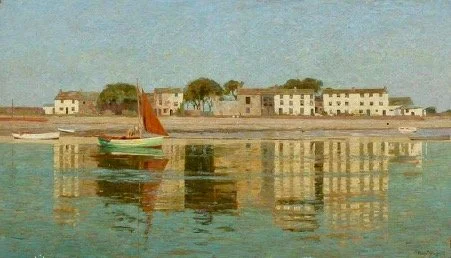
“A forgotten Lancashire Port”, 1905, in the collection of the Manchester Art Gallery.
This time, it’s not the detail but the colour that captivates. The sea and sky, forming the frame, are shades of green and blue; the houses and shore reflected in the river are in yellows and browns, and the eye is drawn to the subtle green and red of the little sailing boat. He conveys an emotion of peace and tranquillity—a colourist painting of the modern era.
When the painting was shown at the Royal Academy in London in 1906, the Manchester Guardian said ‘The most attractive picture by a Manchester man is unquestionably Mr Philip T Gilchrist’s ‘A forgotten Lancashire Port’ which hangs in the first room and both for its beauty of colour and its admirable technique must be regarded as one of the best modern sea scenes in the exhibition Royal Academy’
Philip travels to seek inspiration for his paintings. He is once more in Scotland, and in 1907, he visits Egypt. This significant trip inspired many admired canvases.
Most praise was given to his work (and with his longest title) “Dedicated to the Moon-God: A temple of three thousand years ago”, exhibited in Southampton, Liverpool, and in 1909 at the Royal Academy.
It’s a very different painting, no seas or boats, and it’s nighttime, the light is from the moon.
“Dedicated to the Moon-God, a temple from three thousand years ago” 1908: In a private collection.
‘Dedicated to the Moon-God is a solemn and impressive picture. It does not tell its message to the casual passerby. You must stand some time before you get your eye attuned to it, and divest your mind of the glare of conflicting colours around. Then the sense of mystery and silence and aloofness begins to steal on you. The light of the moon floods the picture. The artist has refrained from introducing any form of life and leaves you alone with the night and the illimitable past. The work narrowly misses actual greatness. (Manchester City News January 1909)
The Studio in 1909 was more down to earth: ‘Temple of the moon God’ gives the true feeling of moonlight, the interpretation of which so many artists treat with an inky brush.”
1910
A year of profound change for Philip: he gets married and decides to live permanently at Sunderland Point, and soon, he will embark on the building of Dolphin House.
He organises a retrospective of his works, shown in Manchester and immediately after, in Glasgow.
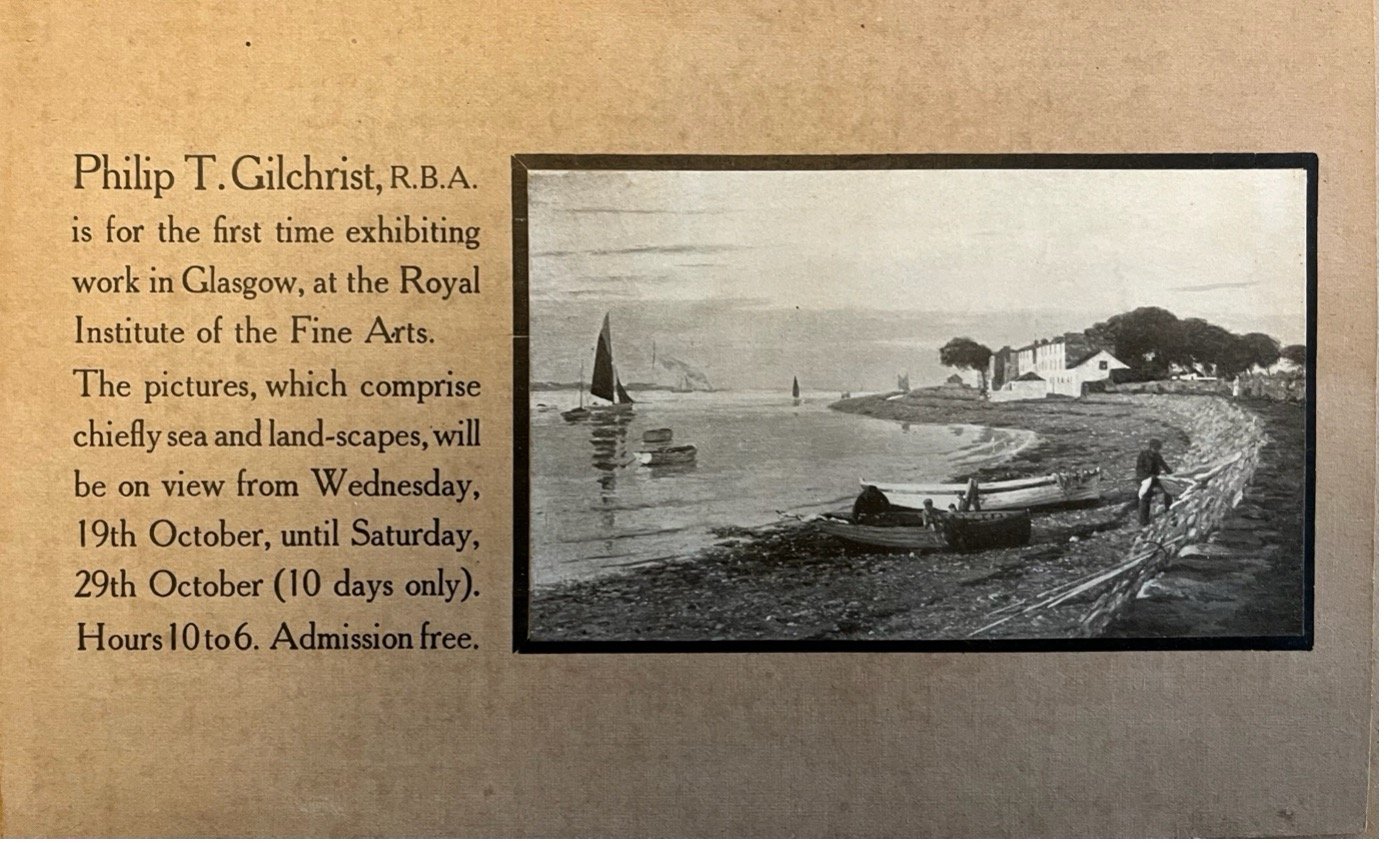
Invitation to the Glasgow exhibition.
The image in the invitation is “Morning on the Lune”, also shown at the Royal Academy in 1909.
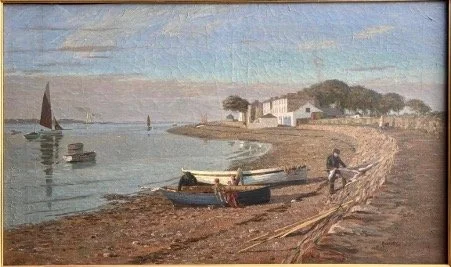
“Morning on the Lune” 1909: In a private collection.
This is an example of Philip merging a realist scene, the fisherfolk going about their daily business, into a marine picture of still waters and gently blended colours.
The exhibition is well received, the Glasgow Times said, “In all the pictures, one can recognise the work of an artist who has not only deftness with the brush but who is an ardent lover of nature in her many moods, especially of calm seas and sunny skies”
However, it’s a Scottish painting that caught the eye; it’s Philip’s most accomplished natural landscape.
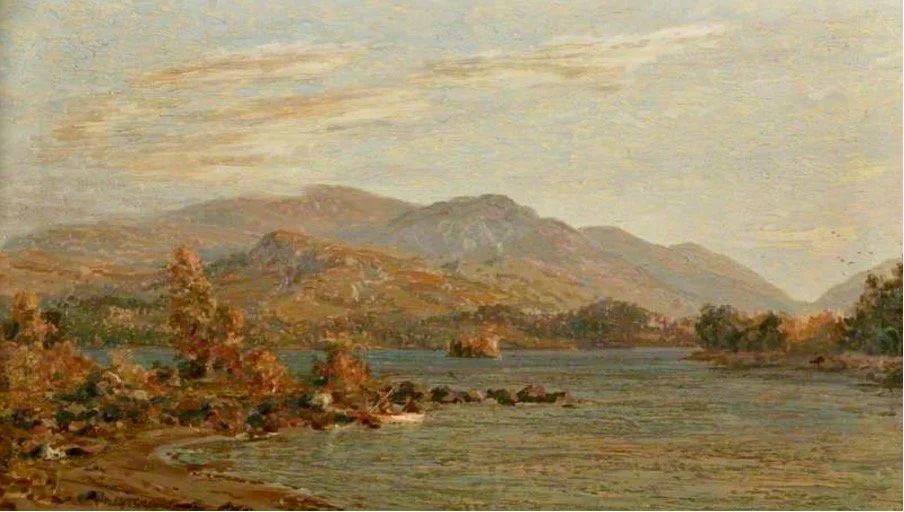
“An October morning – Loch an Eilan” 1908, also shown at the Manchester Academy in 1910, and at the R.A.: In a private collection.
The Manchester Guardian wrote:
“An October morning – Loch an Eilan”, Mr Gilchrist has more than faithfully limned the beauties of autumn by loch and mountain. His imagination gives us a glorious Vista of cloud reflecting waters, a wondrous sky, the russet and gold of bracken and Heather, and an enchanting sense of atmosphere. It is the poetical spirit of autumn, garbed in her regal splendour.”
Philip poured immense energy into the design and construction of Dolphin House. Only a few paintings were completed during this period; one of these is “The Rainbow”. It is a favourite of Philip’s and a technical masterwork.
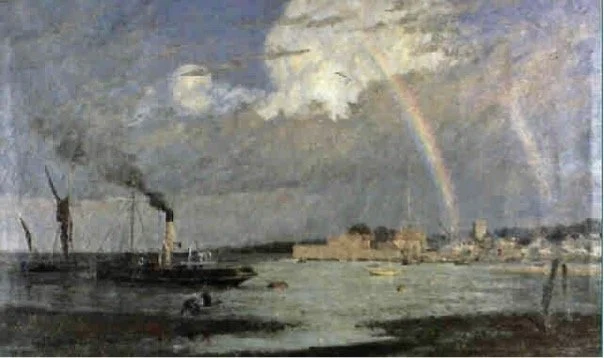
“The Rainbow” 1912. Yarmouth, Isle of Wight. Also, at the Royal British Academy in 1915
He skillfully captures both sunshine and rain within the same scene. The sun, which produces the double rainbow, is reflected in the central cloud and on the sea; elsewhere, the cloud cover is dense and ominous. Gentle strokes of shadow indicate that it is currently raining.
It must be special to Philip, as he later gave it to his sisters Anne and Helen for their home in Stodday.
The later years
Between 1930 and 1956, Philip created only 15 paintings and sketches, some reworked from earlier works. He remained a member of the Southport Pallet Club and occasionally submitted paintings for exhibition.
In a further and interesting display of versatility, Philip draws inspiration from mythology.
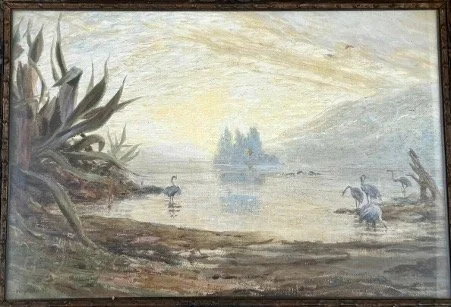
Isle of Ulysses, Corfu, Southport Palette Club 1936, and at the Royal British Academy, spring 1937 Coronation Exhibition.
In this magical picture, Philip has depicted the enchanted Isle shimmering in the mists of a placid sea, with exotic plants, birds, and other creatures flourishing along its shores. It was inspired by the Greek hero Odysseus, also known as Ulysses, who, following the end of the Trojan War, embarked on a series of adventures recounted in Homer's Odyssey.
And there is this –
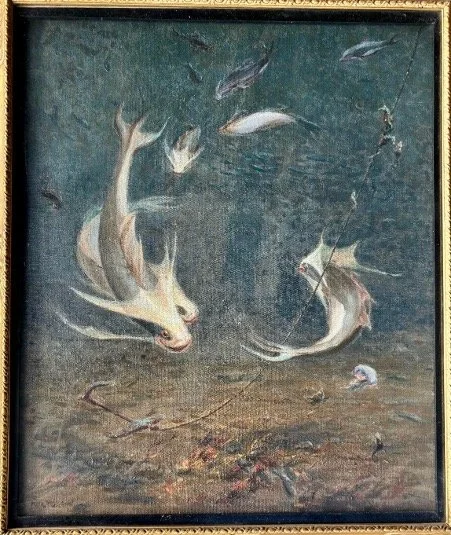
“The spell to make the anchor hold”, 1951. (A second attempt, the first was in 1938).
The idea of the Dolphin as a mythological creature had been with Philip since his visit to the Amazon in the early 1900s. It was believed that their magical powers saved mariners from drowning. Dolphins seen on the surface could morph into fantastical creatures, as we see here, and could ensure a ship’s anchor held fast in stormy seas.
Philip used the dolphin as a motif on stained-glass panels for his home, as well as in carved wood, stone, and copper. Philip is thinking of its talismanic properties, living close to the sea, but he is also amused by it.
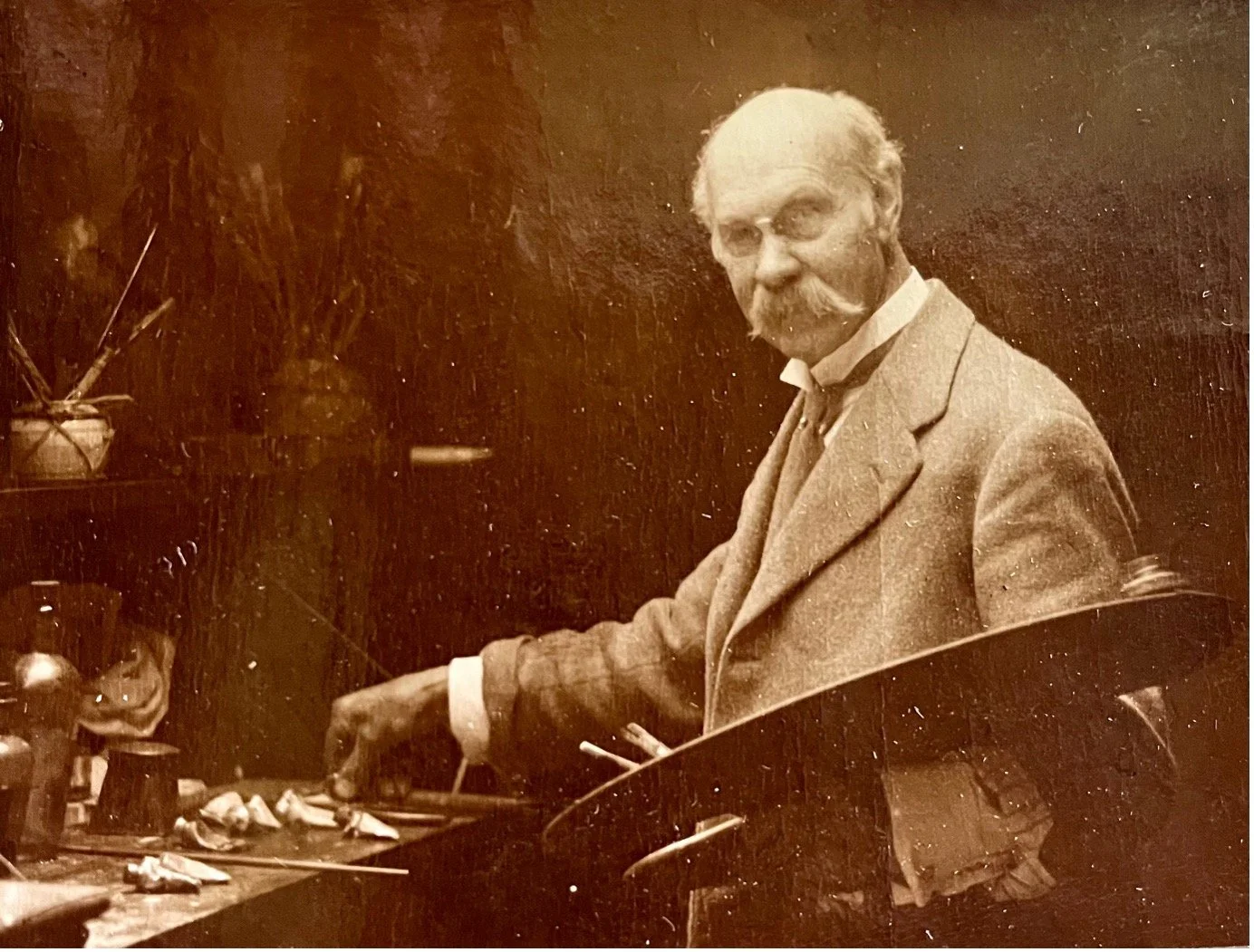
Philip T. Gilchrist R.B.A. at work with paints and palette, c1934.
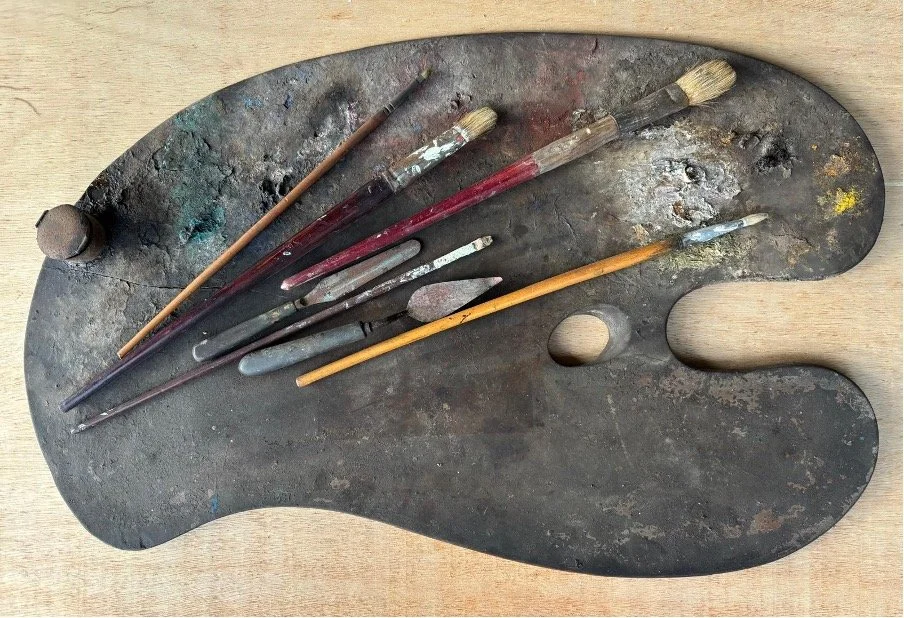
And here is his palette
His legacy
Philip died at Sunderland Point in 1956. He leaves behind many outstanding paintings inspired by boats at sea, his extensive travels, ancient history and mythology. Philip was a realist painter attentive to fine detail, especially in his depictions of ships. Above all, he was a colourist, capable of conveying great interest and emotion.
We strongly agree with the Glasgow Herald, which wrote in 1910 after viewing his exhibition of nearly 80 paintings.
“But perhaps Mr Gilchrist is seen in his happiest mood in his rendering of the scenery around Sunderland Point, which is his homeland. There is not only a fine Craftsman in such work as “The Lune Estuary at Low Water”, “Morning on the Lune” and “A forgotten Lancashire Port”; They reveal also an intimacy of spirit, they are not a mere transcript of things seen, they are illuminated by an imaginative observation. “
The gallery link is here. Please take a moment to browse through it.
We give special thanks to the Gilchrist family for the open access to their collection of Philip’s paintings and material about his life, and for permission to publish on the website. Next time, a full biography of Philip.