Gravel Cottage
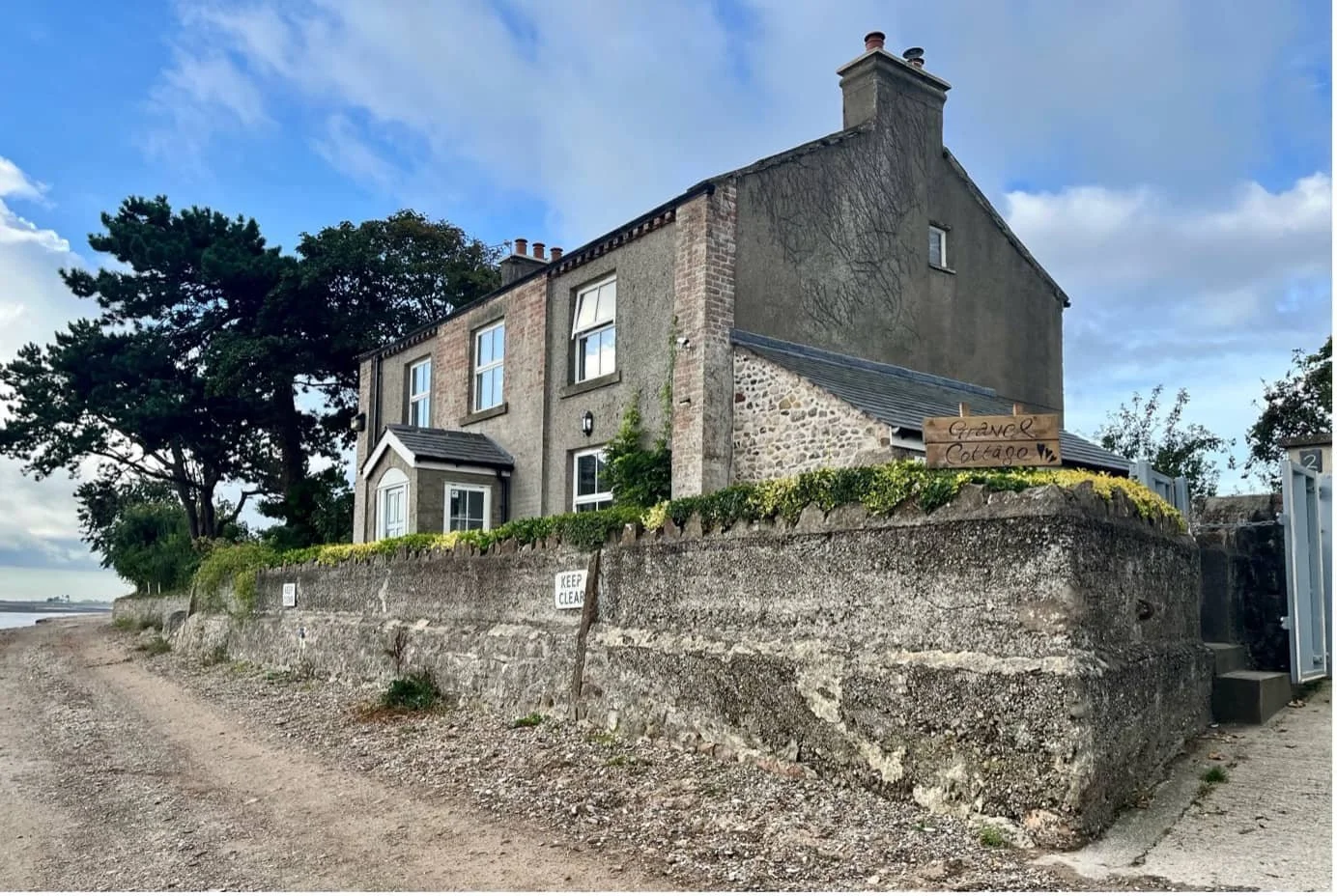
Gravel Cottage 2025: Website collection
The project to compile a short history of all the houses at Sunderland Point is almost complete. As Gravel Cottage is of great interest, we have written this special article.
Possibly dating to the 1720s, it is one of the oldest houses, and closely mirrors the history of the village. It was originally built by the Lawson family as a shipbuilding workshop to support their merchant and maritime ventures, it became a seaside lodging house, and for many years a home for fisherfolks.
The Blockmaker’s Shop
It was here in 1739 when the third and final legal quay at the Point was authorised. The quays were officially approved locations for the landing of imported goods and for taxation. Its presence confirms Sunderland’s importance as a bustling 18th-century trading port.
The boundry wording reads ‘thence Northwards to a certain other Stone Post or Boundary fixt opposite to the North end of a certain Blockmakers Shop at Sunderland aforesaid belonging to Mr Robert Lawson markt “N.1739” in length from North to South about 510 yards and bounded on the East side by the River Loyne and on the West side by the Houses and lands at Sunderland aforesaid.’
The marker stone ‘N.1739’ has been lost, but the South marker stone still exists next to Cotton Tree Cottage. If we measure 510 yards from this stone, the location of the North stone would have been at Gravel Cottage.
The 1739 quay is shown in green on the map below.
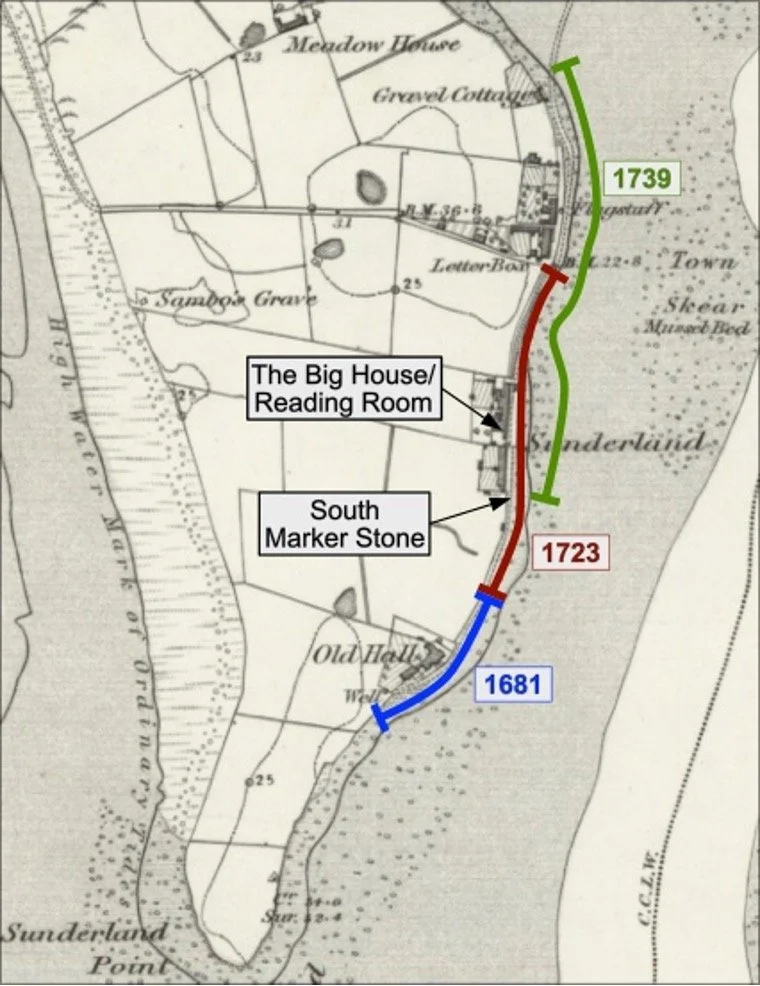
The locations of the three legal quays at Sunderland Point were established through the research of Doug Welch. Map courtesy of the National Library of Scotland. The coloured illustration of the quays is by Paul Hatton.
Used for the manufacture of ship rigging, it also served as a blacksmith's shop. Hugh Cunliffe, in his history of the village, imagines that John Skelding, listed in the parish registers as a blacksmith at Sunderland in 1720, worked there.
Hugh also says, ‘There was an archway in the southern-facing wall through which small boats could be pulled or rolled for the Smith to work on. This filled-in archway was uncovered by builders as recently as September 1981 and then covered again’
Here it is:
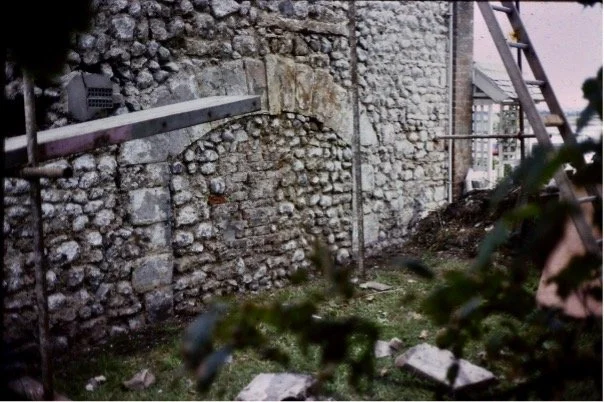
The arch in the wall at Gravel Cottage: Photo courtesy of the Gilchrist family
When Robert Lawson died in 1773, the property was known as the ‘little warehouse’, reflecting a shift in use as shipbuilding and repair had moved to Lancaster. Ownership passed to his sons-in-law, who sold it in 1779 to ‘George Jackson of Sunderland’.
George Jackson
George owned the Ship Inn, Upsteps Cottage, and the fields, mainly on the southern side of the Lane. He likely bought the property to convert into two cottages for use as summer lodgings for visitors during the heady days when the village was a seaside spa known as ‘Little Brighton upon the Lune’
We don’t know who came to stay in the busy spa years, but as popularity waned, the cottages became occupied year-round by weaving families who had relocated from Overton to add fishing to their livelihoods.
By 1841, the Curwen family lived in the first Gravel cottage, and in the second cottage lived the Spencer family.
The Curwen Family
In the 1841 census, William Curwen, aged 55, lived here with his wife, Sarah, aged 50, and their 20-year-old son, William. They must have lived in the house for a long time, as the baptismal records show that their third child was born in Sunderland in 1810.
This is a great village family. William was born around 1784 in Pilling, and in 1807, he married Sarah Woodhouse in Lancaster Priory Church, a member of the Woodhouse boatbuilding family in Overton.
They had eleven children. William, above, was their fourth. He was a fisherman who never married.
Thomas, their eighth child born in 1825, also became a fisherman and pilot. He married Ann Shackleton in 1848, and they lived for a time at number 6 First Terrace before moving to Roa Island off Barrow.
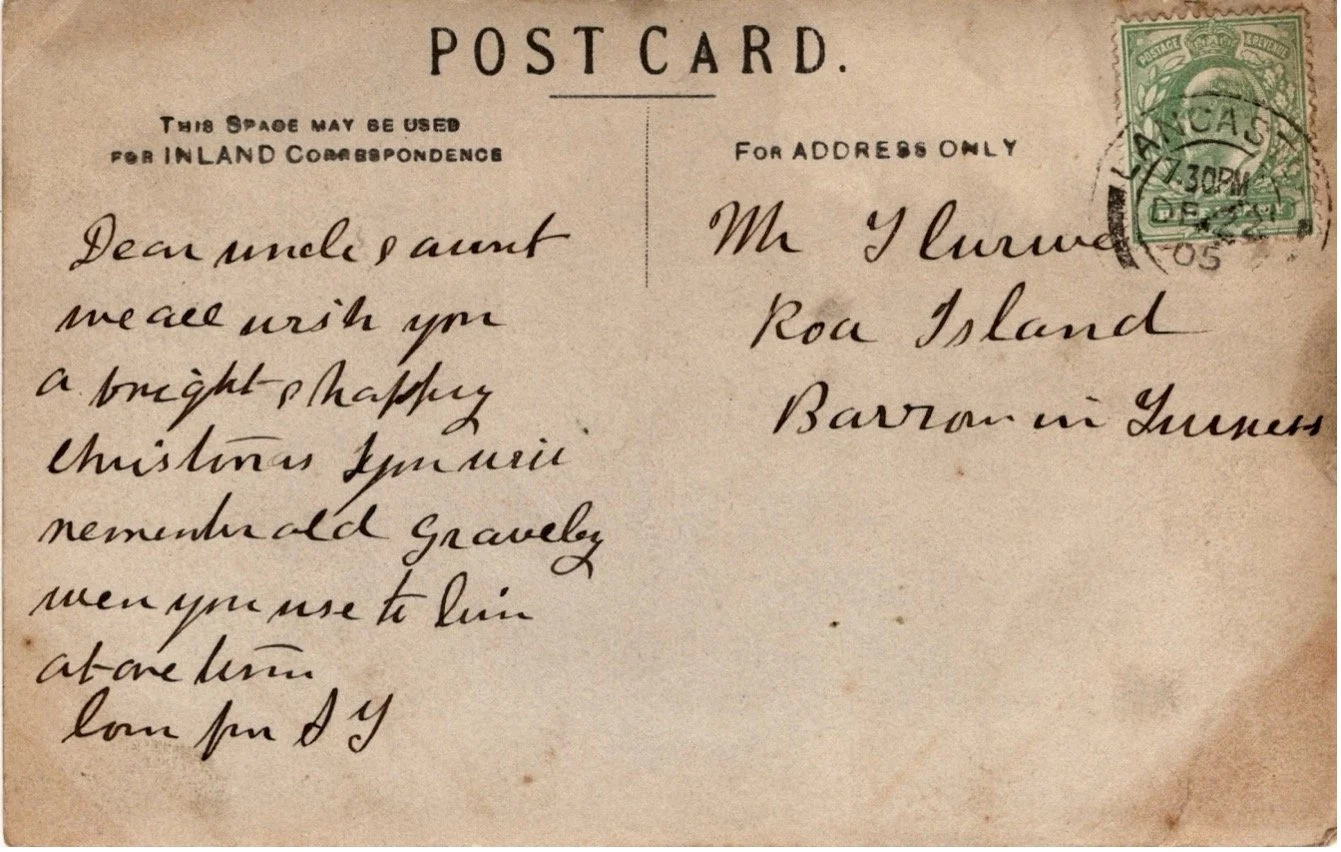
From the collection of Rosemary Lawn
A Christmas greeting sent in 1905 to Thomas Curwen, aged 80, still living on Roa Island, by a niece or nephew reads, "Dear Uncle and Aunt, we all wish you a bright & happy Christmas. If you will remember old Gravely, where you used to live at one time."
The last, and eleventh, child, Margaret, was baptised in 1826 and married William Townley of Poulton-le-Sands (Morecambe). They moved to number 23 and started another great village dynasty.
It’s 200 years since Margaret’s birth. Here she is in later life with William Townley
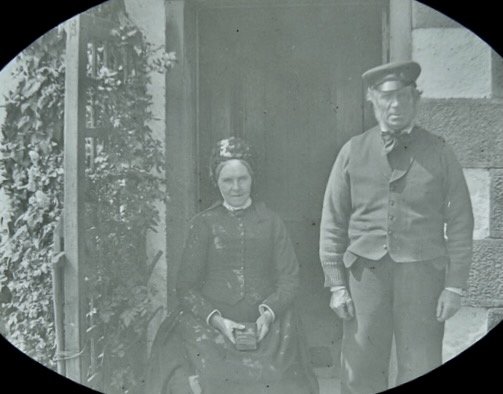
Margaret (nee Curwen) and William Townley outside number 23, c. 1900: A photograph by George Gilchrist the younger, courtesy of the Gilchrist family.
William senior died in 1851. In the 1861 census, his son, William, was living in the house with his widowed mother, Sarah.
In 1863, he was one of the three village men who drowned in a tragic accident on the return journey from a visit to relatives on Piel Island, near Barrow. (for the full story, follow this link to our article here)
This left Sarah alone. It’s imagined that her large family would have given her strong support. She would have benefited from the small relief fund collected for the bereaved families of those who had drowned.
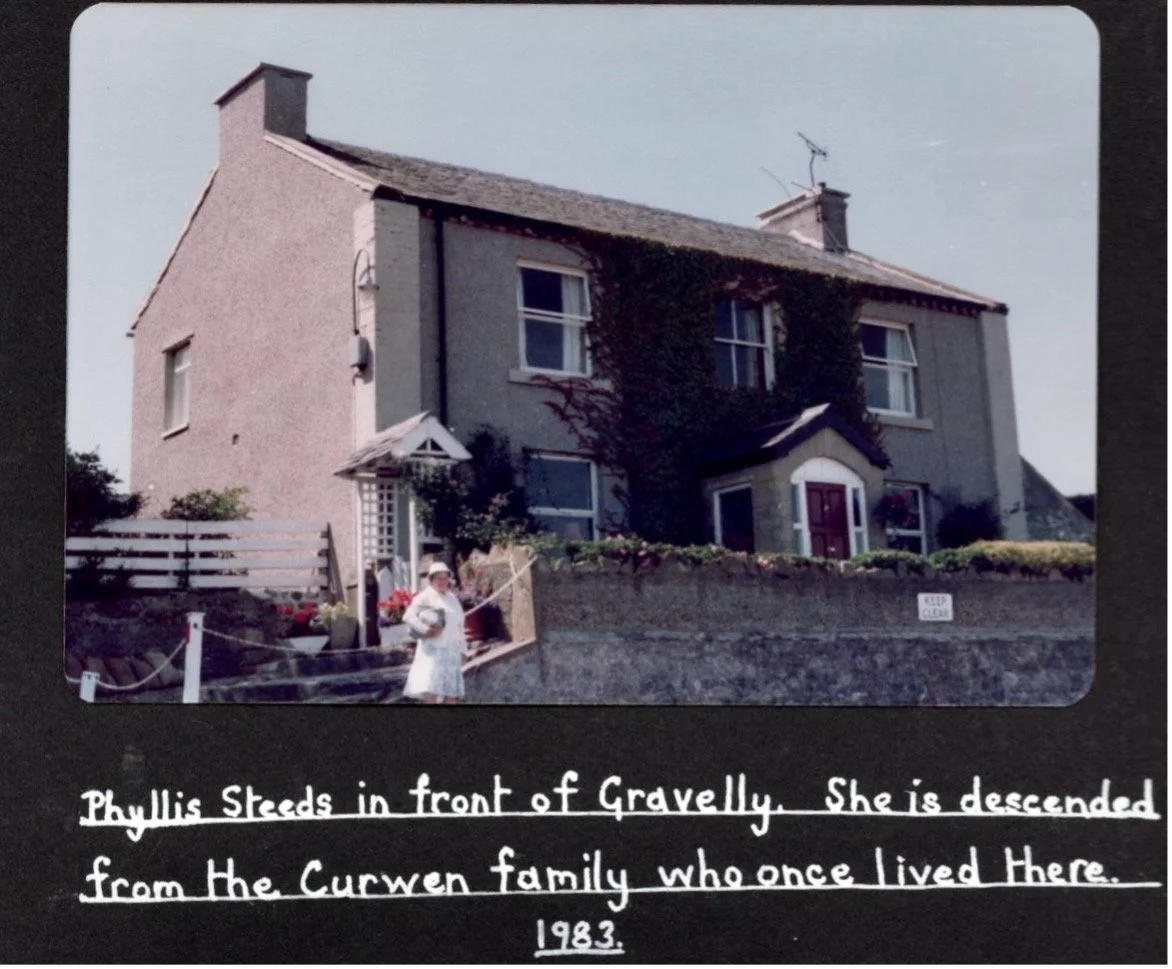
From the collection of Hugh Cunliffe.
This is from Hugh Cunliffe’s scrapbook. Phyllis Steeds, a descendant of the Curwen family who lived in New Zealand, visited the village to see her ancestors’ birthplace. Phyllis has been traced back to Isabella, William and Sarah’s ninth child, who emigrated to New Zealand.
The Spencer Family
Another great village dynasty. In the 1841 census, John Spencer, aged 50, and his wife, Mary, aged 45, were in the second cottage. John had been a weaver. He was listed as an agricultural labourer and later became a fisherman. He died in 1845 at the age of 54.
They had four children, three of whom were boys.
In 1851, in another tragic accident, their eldest son, John, drowned.
On 9th August 1851, the Lancaster Gazette reported that the body of a man named John Spencer of Sunderland was found on Cockerham Sands. He was 27 years old and had left behind a wife and child.
In the 1861 census, only Mary Spencer is present in the house, a 69-year-old widow.
One of their other sons, James, lived his entire life in the village, from here to Upsteps Cottage after he married and later in number 10. His son Thomas would build the two semi-detached cottages in the Lane and live in one of them.
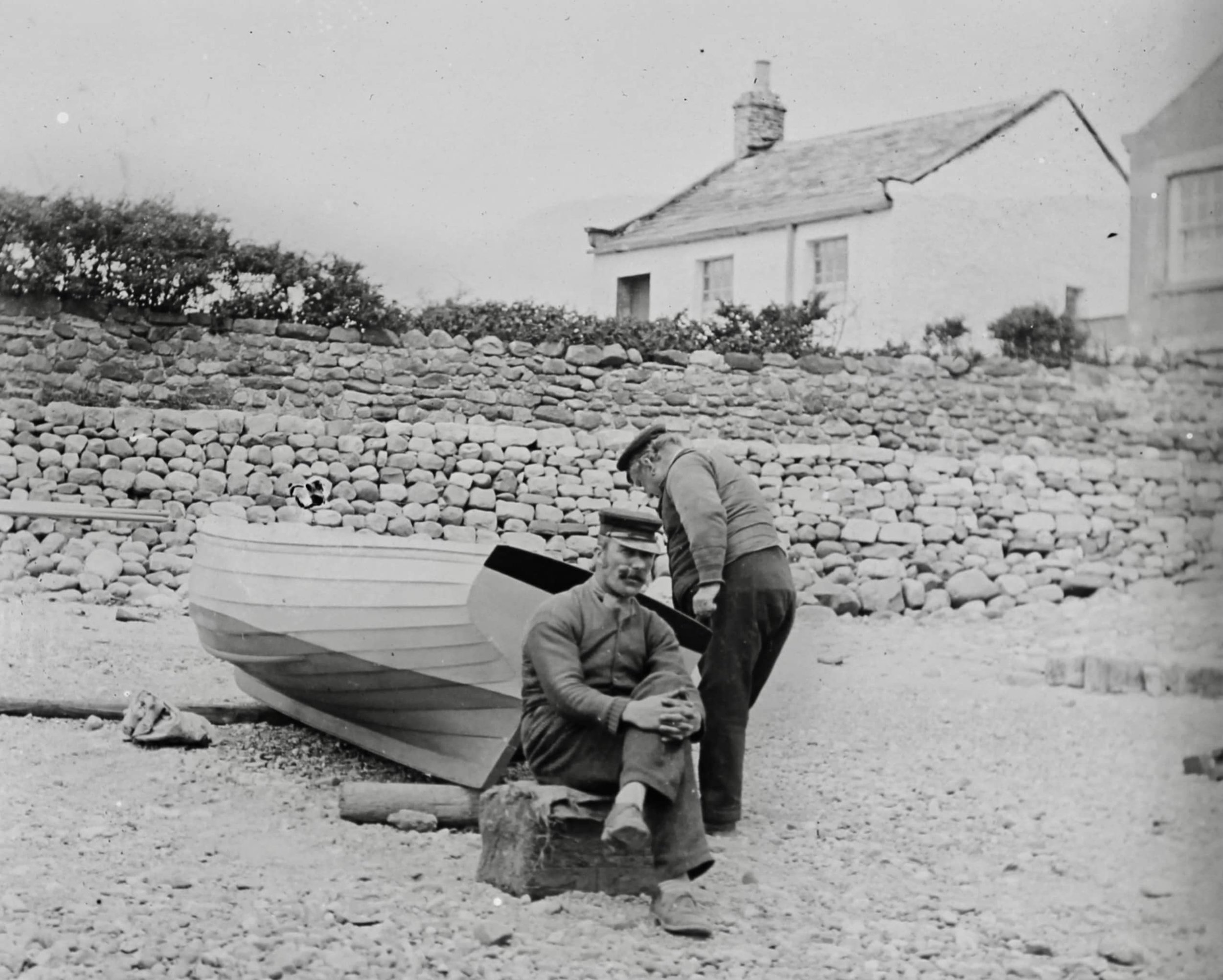
Tom Spencer (front), and James boat painting on the shore, with Upsteps Cottage in the background, c1900: A John Walker photo courtesy of Lancaster City Museums.
Gravel Hall
In 1879, both cottages were sold to Thomas Jackson, a fisherman from Overton and his wife, Margaret. They renovated and merged the cottages into a single property, welcoming summer visitors to supplement their income. They named the new house ‘Gravel Hall’.
Two years later, yet again, their son Thomas tragically drowned. A report of the incident and the inquest was published in the Gazette in July 1881. The father, Thomas, formally declared at the inquest, ‘that the deceased was my son and he was 17 years of age and a fisherman.’
In James W. Gardner’s notes, he says, ‘ Tom drowned one Sunday morning after taking people to church by boat. He and another chap were sailing around in a punt, and it capsized on Chapel bank.’
Belle, born in 1872, one of Thomas and Margaret’s daughters, was married to James ‘Shirley’ Gardner and lived in the Summer House at the top of the Lane for many years.
James W. Gardner, who knew Tom Jackson well, wrote that Tom was his first salmon-fishing partner and a short-tempered man. James recalls this amusing incident:
Tom Jackson, the man with whom I fished that first season, used to poach fish and salt them down in the dolly tub. Once, he had been poaching under Ashton Wood, and he caught four salmon. On his way home at about two o’clock in the morning, he had to pass through the churchyard to get to Overton. He had just got over the stile into the churchyard when one of the salmon in the sack on his back jumped. He dropped the sack and left it; however, he mustered enough courage to pick it up again and bring it home. That episode ended his poaching.
Some photos of Margaret and Tom
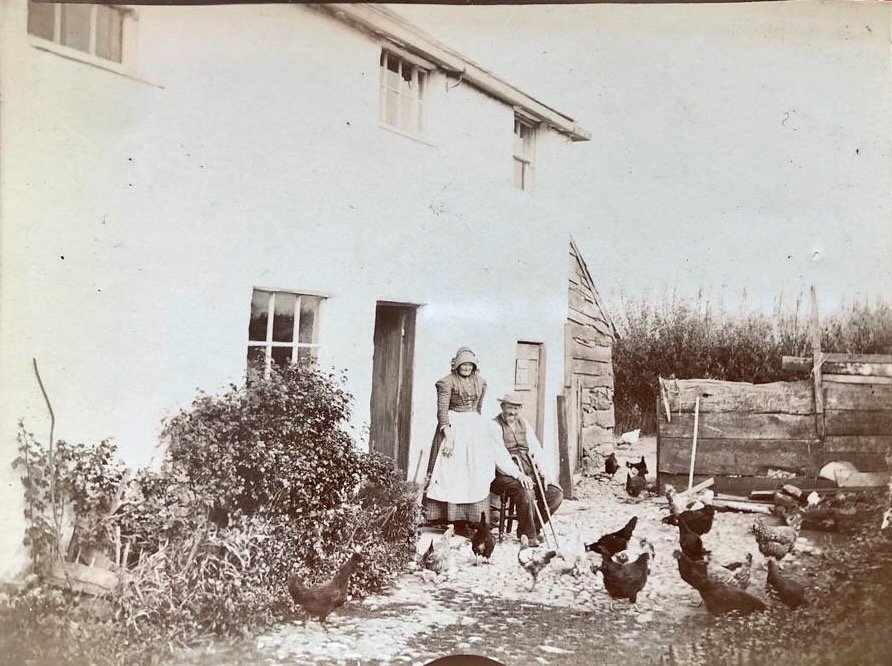
Thomas and Margaret Jackson at the rear of Gravel Cottage, c1890s: Courtesy of the Gilchrist Family
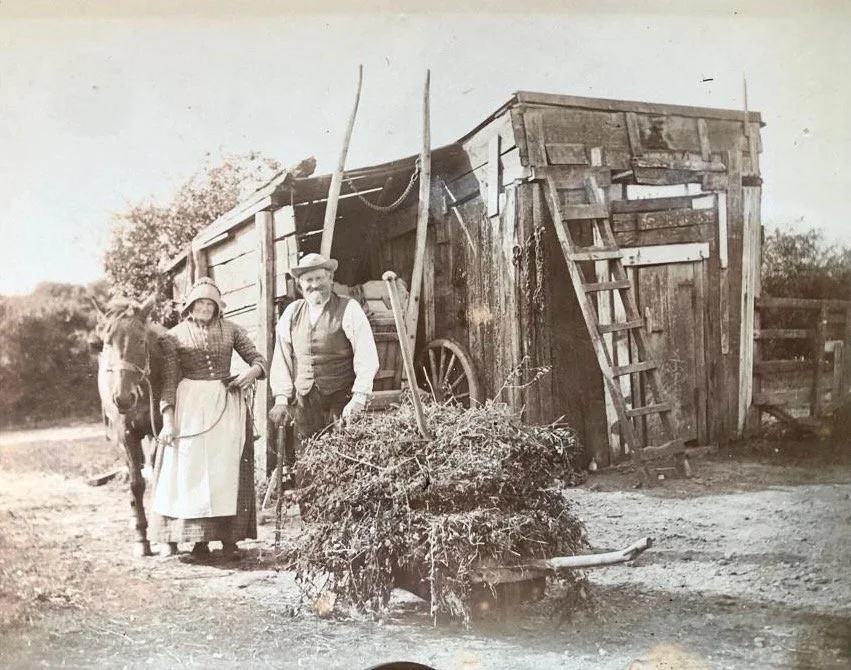
Thomas and Margaret Jackson at the rear of Gravel Cottage, c1890s: Courtesy of the Gilchrist Family
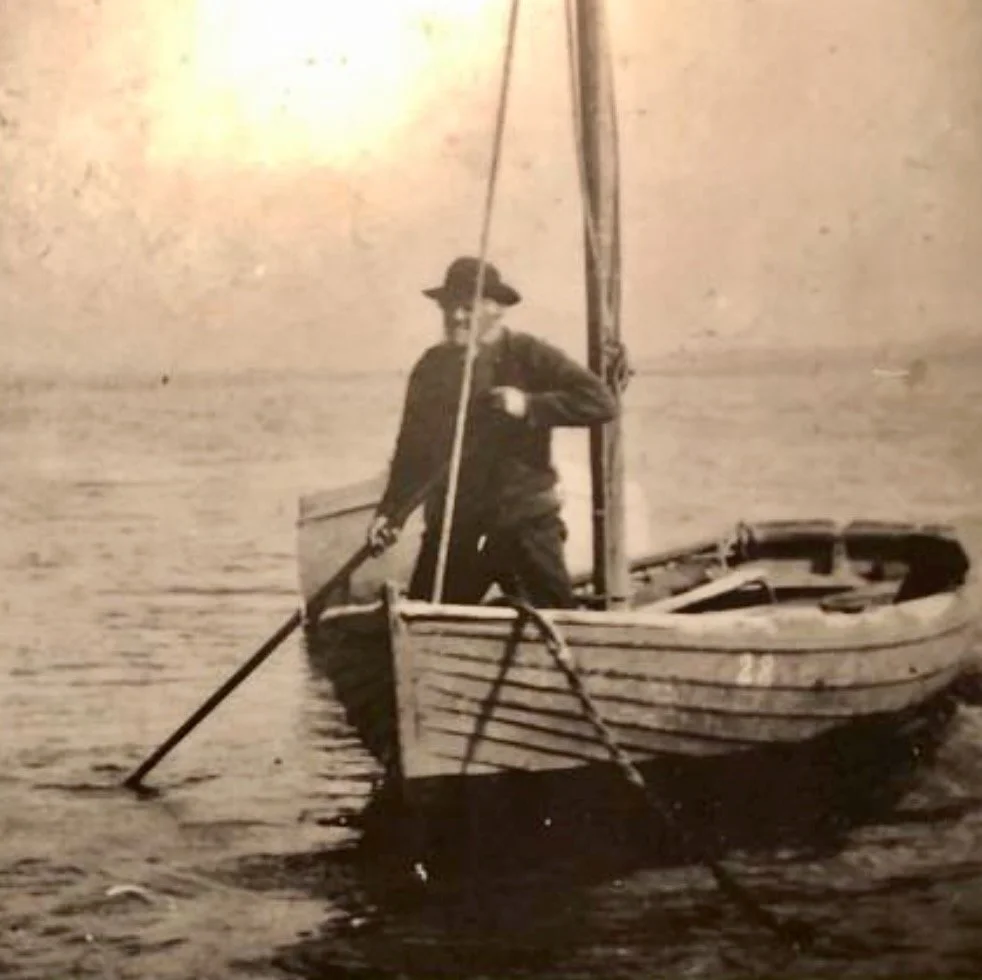
Thomas Jackson is bringing a boat ashore in the 1890s. Collection Alan Smith
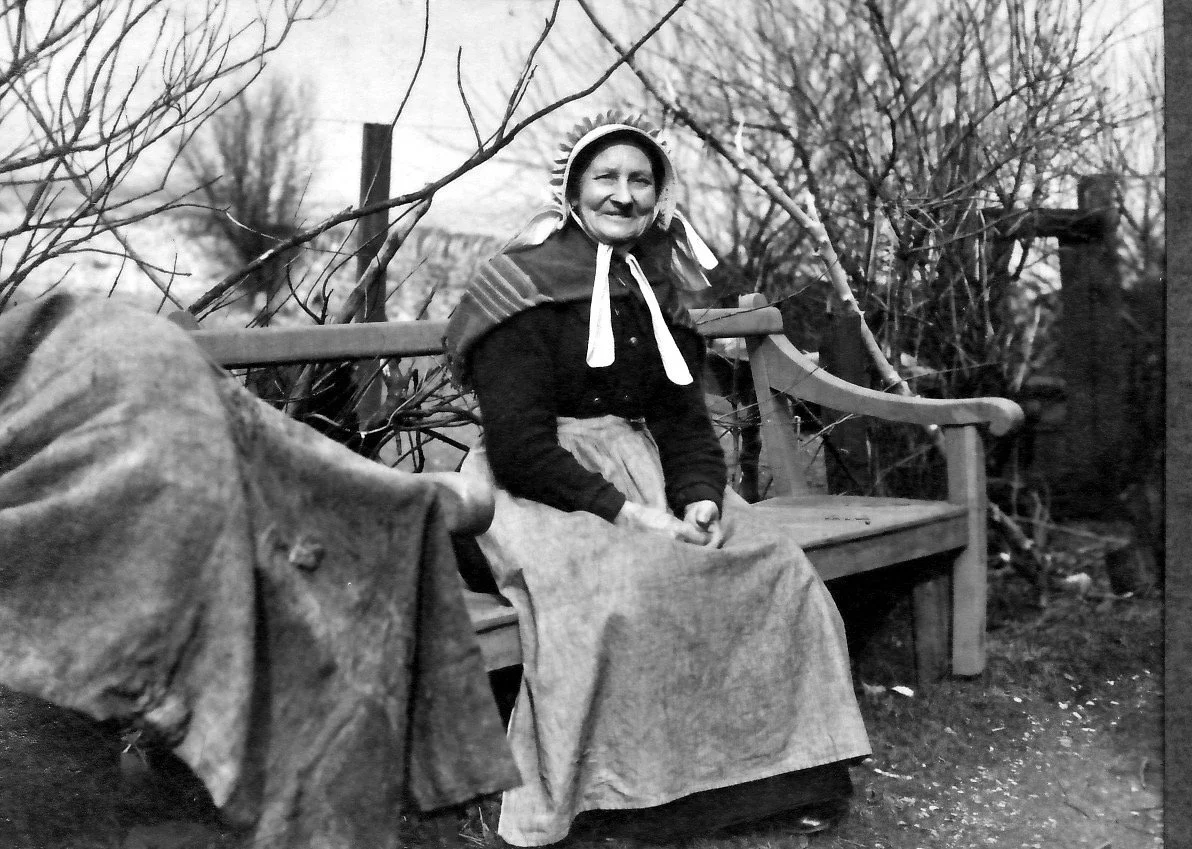
Margaret Jackson, now a widow outside Gravel Cottage, c1910: From the collection of the Gilchrist family.
In a list of visitors in 1894, a Mr, Mrs & Master E Taylor of Manchester are at the cottage with Margaret.
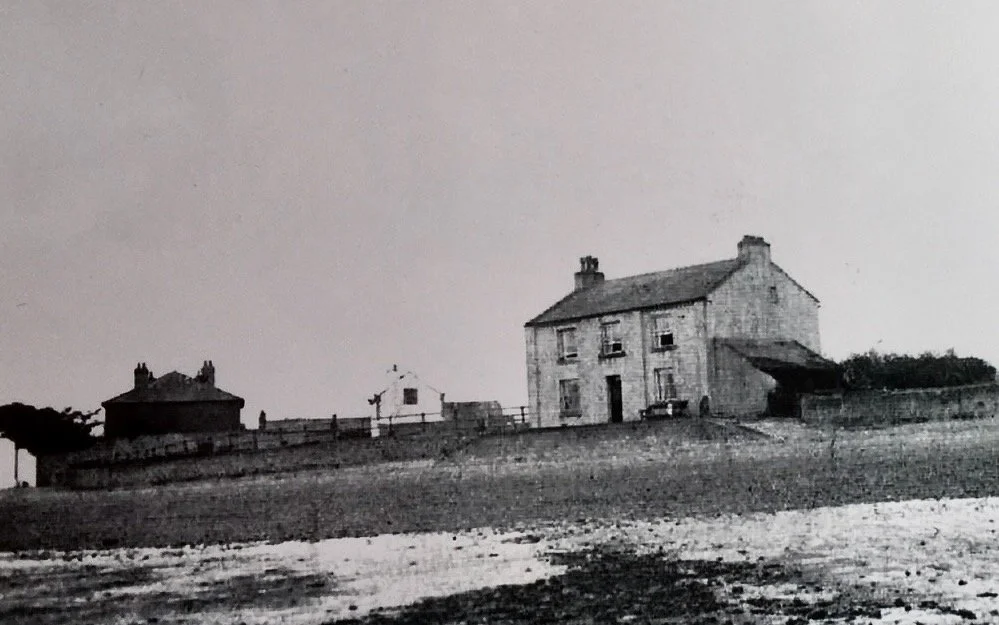
Gravel Cottage c1900: Website collection
Thomas Jackson died in 1899 at the age of 68. Margaret outlived him by many years and died in 1920 at the age of 90. After her death, the property was sold to Dora Swainson, the wife of William G. Swainson, a vicar in Rainhill, Liverpool. Dora’s sister Theo and brother Philip were living in the village.
Captain Tom Gardner
In 1921, Thomas Gardner returned to the village. In the census, he is recorded as a widower, aged 36, and a lieutenant in the Army. With him are his three daughters, Alice aged 10, Gwendoline aged 11, and Ladas aged 13, and a housekeeper, 34-year-old Margaret Yeats.
Known as ‘Captain Tom’, he was the eldest son of James and Betty Gardner and was born in the Summer House.
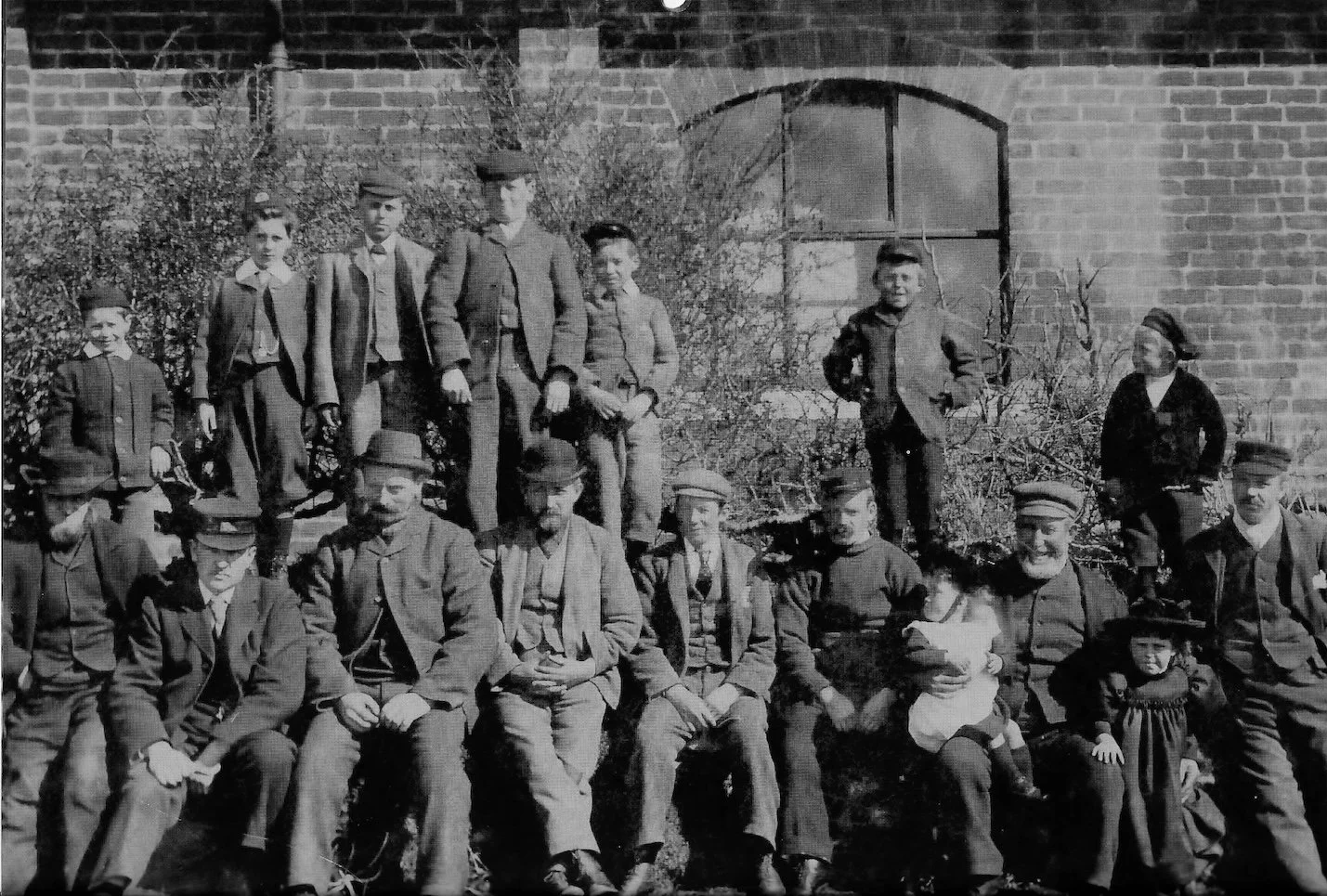
Thomas is at the back, third from the left, next to the large Gerard Bagot, in the 1894 group photo in front of the Mission Church. His father, James, sits to the left of Luke Gardner, who has Tom’s sisters on his knee: From the collection of Alan Smith
In 1906, Tom, who had become a policeman, married Gertie Johnson, and they lived in Lancaster.
On the outbreak of war in 1914, he enlisted in the Scots Guards and served on the Western Front with the First Battalion, Royal Lancaster Regiment (King’s Own), in the Machine Gun Corps.
He must have shown great ability, as in 1917 he was promoted to captain and served as an instructor at an officers' school.
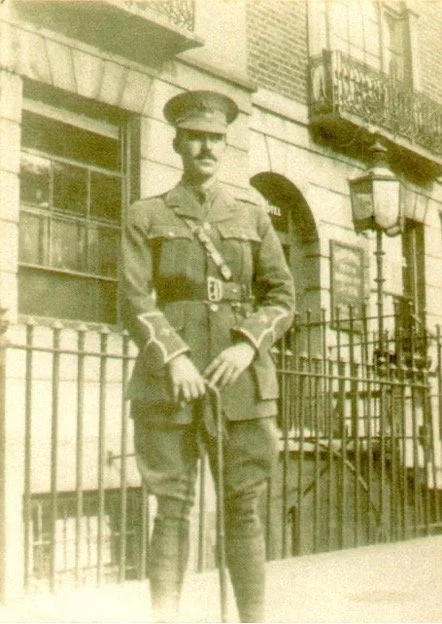
Captain Tom Gardner c1918: Collection Kris Needham
In 1918, Gertie died of TB at the young age of 31, leaving four young children, who had to be placed with local relatives. After spells in Belgium and Dublin, Tom was reunited with his three daughters at Gravel Cottage, but his son, Tom, stayed in Glasson Dock with his grandmother.
Tom takes up fishing and keeps livestock in the house’s large garden.
In this 1922 postcard of children walking home from school, the three Gardner daughters, Ladas, Gwen, and Alice, are the ones dressed in dark blue. From the collection of Wilton Atkinson.
In October 1927, the village experienced a terrible storm, and the sea flooded much of the Point. Philip T. Gilchrist wrote a letter to his sister, Dora, in which he vividly described what had happened. (link to our story on the flood)
This was included in his letter (the house was then known as Gravelly)
‘Gravelly had a dreadful time. Tom had the turkey, and a significant number of young hens drowned. He has saved the pig by floating it on a sort of raft to the house, and now it is in the cupboard kind of place under the staircase! They are anxious, as you can understand, for the waters to subside. His piano stands on two boxes.
And this incident with ‘piggy’
It was in the dark, of course, that Tom Gardner [Gravelly] saved his pig. Floating it, he pulled by an ear. When the raft came aground, Piggy refused to come off and walk, and Tom fell into the water, pulling his beast. As soon as the pig saw the light in the door of the house, it made for it, and there was no more trouble.
Thomas lived in Gravelly until 1939, when he married Lily Yeats, the sister of his housekeeper, and moved to Goosnargh. Tom died in 1961.
Ada and Clara Gerrard
In 1940, sisters Ada and Clara Gerrard took the tenancy. They had both been primary school teachers in Liverpool and were no strangers to the village - they had owned number 8 as a holiday home for more than 25 years (1915–1942).
Wendy Crokett, a grandniece of the Gerrard sisters, wrote in fascinating detail about Gravelly and her aunts during childhood holiday visits in the 1960s. (For full details, see her article.)
Wendy wrote of Gravelly:
Gravelly was furnished with items from their much larger family home in Liverpool, and ornate mahogany wardrobes and heavily framed religious scenes crowded the small rooms. The dining room door opened with a quiet swish from the dark drape of a draught-excluding curtain, and behind it was an out-of-tune piano (which we weren’t allowed to play)
Of her aunts and the housekeeper
I scarcely remember Aunty Clara, who died when I was very young, and was regarded as the fun-loving aunt. Aunty Ada, whom I remember well, was a good deal more aloof. She was very fortunate to have a housekeeper, Nellie Jones, who had begun as a maid of all work with the family in Liverpool when she was very young. Nellie somehow coped with all the inconvenience of a cold and draughty house with no modern conveniences, the periodic storm damage, and the lack of transport.
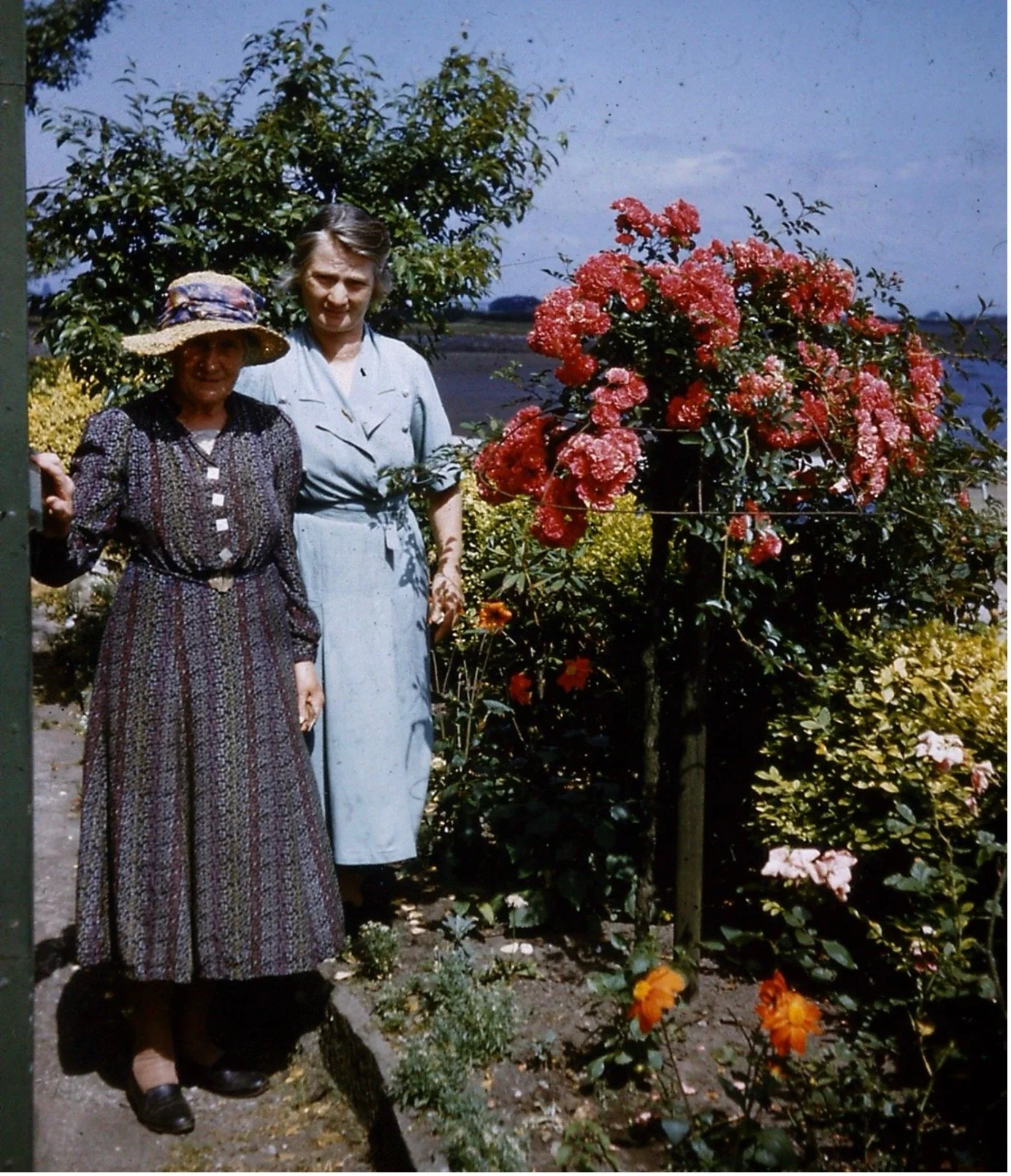
Ada Gerrard and Nellie Jones outside Gravelly, c. 1960. A Peter Hall Photograph
Ada reached the age of 100 in 1969, and, in addition to a telegram from the Queen, the flag was flown on Second Terrace.
Bernard and Margaret Darby
After Ada’s death, the tenancy passed to Bernard and Margaret Darby, who had been living at Cotton Tree Cottage. Margaret’s elderly parents moved in with them. The Darbys owned ‘Scott-Richmond’, a highly regarded ladies’ and gentlemen’s outfitters, with shops in New Street, Lancaster, and Yorkshire Street, Morecambe. For a time in the 1970s, Bernard served as Chair of Overton Parish Council.
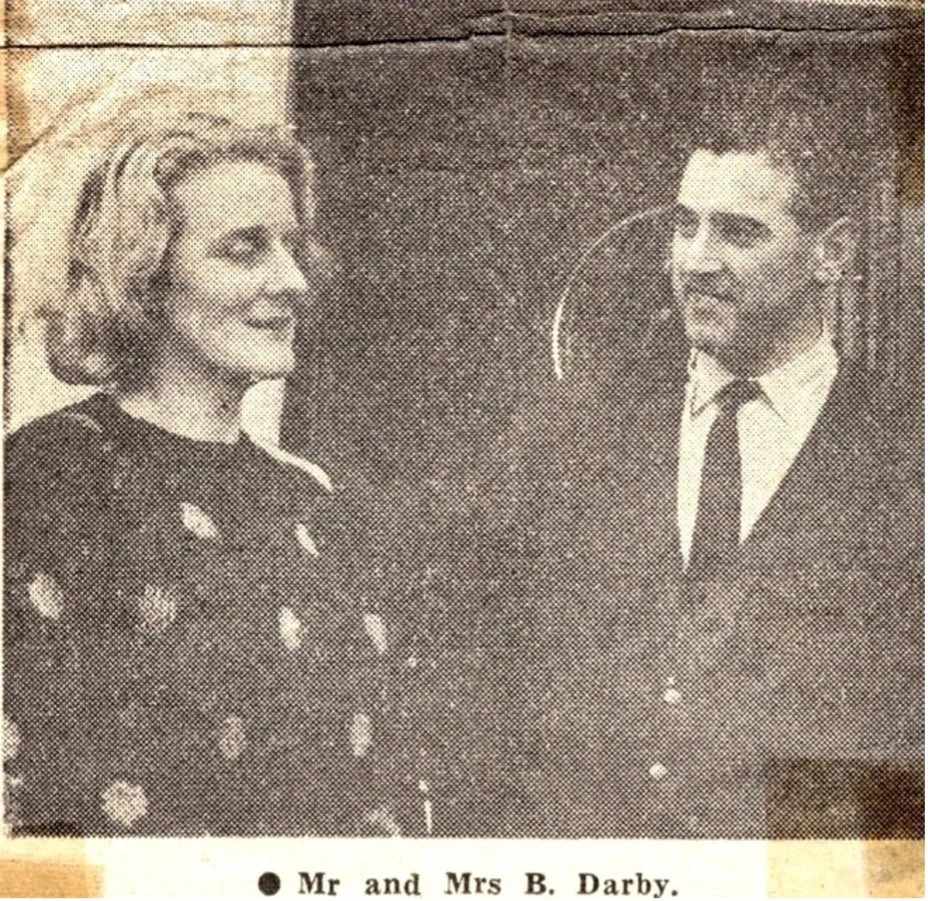
A newspaper photograph of Margaret and Bernard Derby in 1964.
Bernard died in 1991, and Margaret in 2022.
The future
After a substantial renovation, the house was bought by Jeff and Lin Bellamy. For Lin, living at Sunderland Point is a dream come true, and she says the only way she will leave will be in a box.
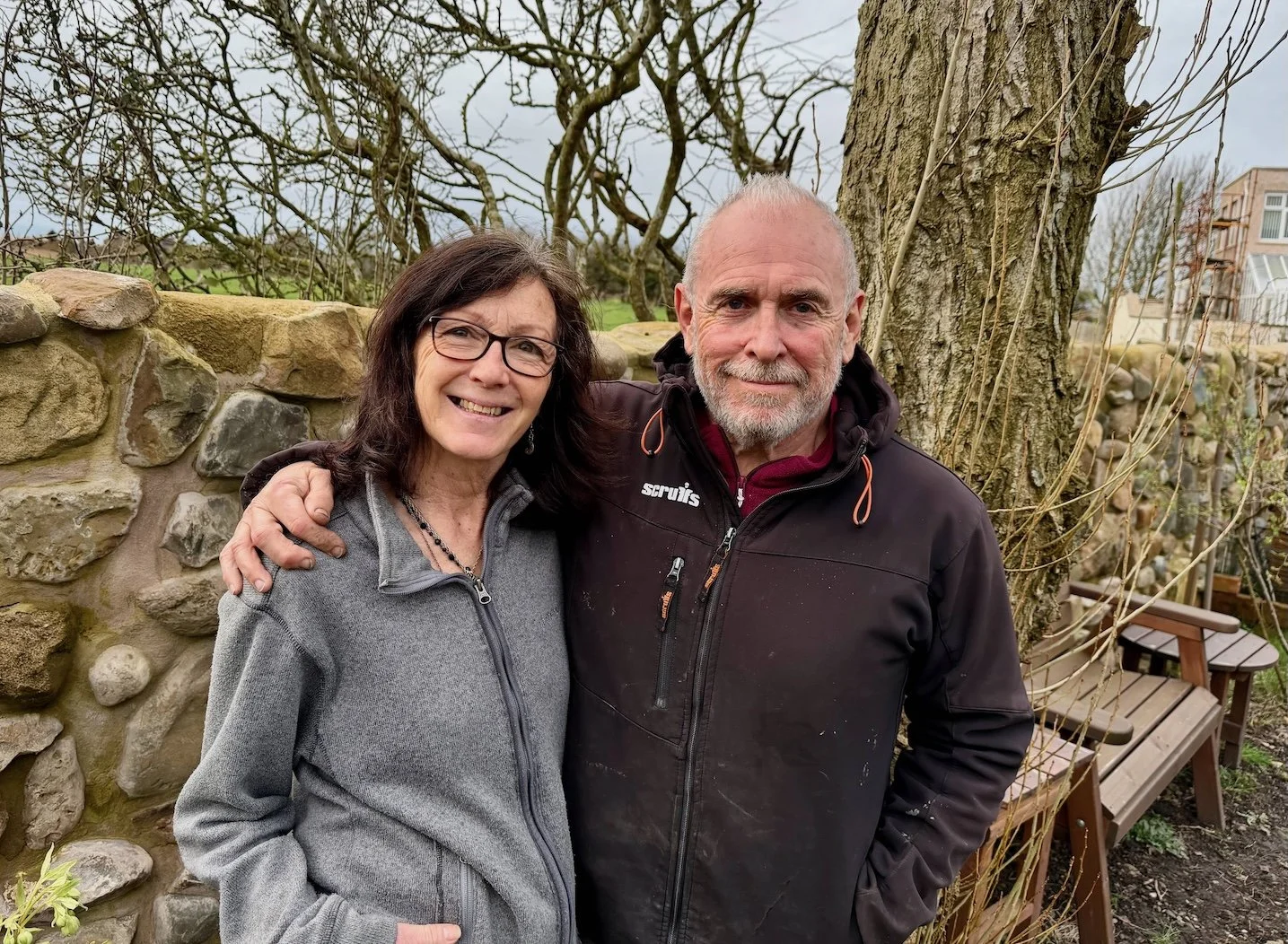
Lin and Jeff Belamy: Website photo
Now three centuries old, originally built for the maritime trades of shipbuilding and repair, Gravel Cottage, fully renovated, looks smart and ready for another 300 years
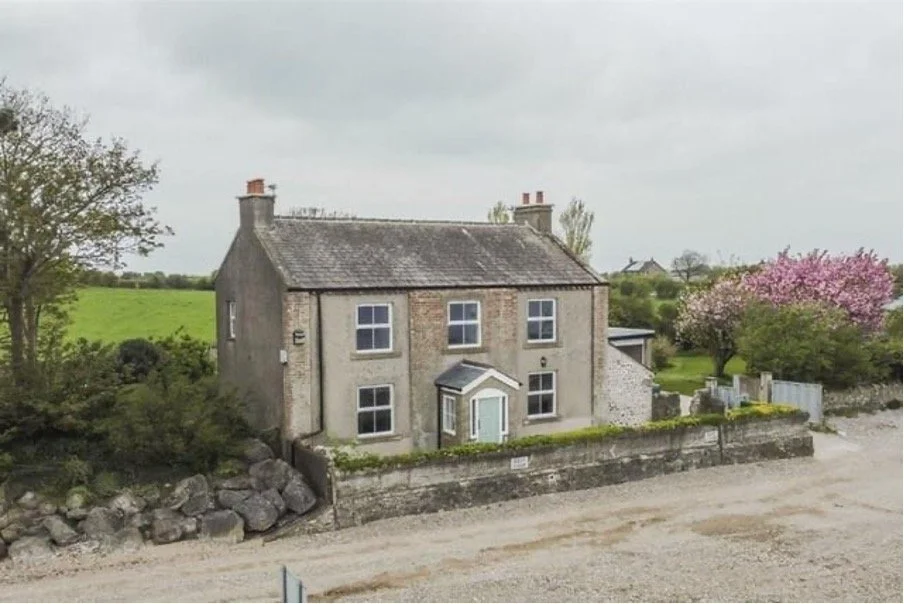
Many thanks to Lin and Jeff for allowing us to use their house for this article, and to Kris Needham and Ann Hatton for in-depth research. Next time, Philip T. Gilchrist.