The attempt to identify a list of names
In the two articles on the Point as a seawater spa, published last autumn, we found it hard to convince ourselves that it was as popular and significant as it appeared. The lists of visitors in 1818 provides clear proof!!
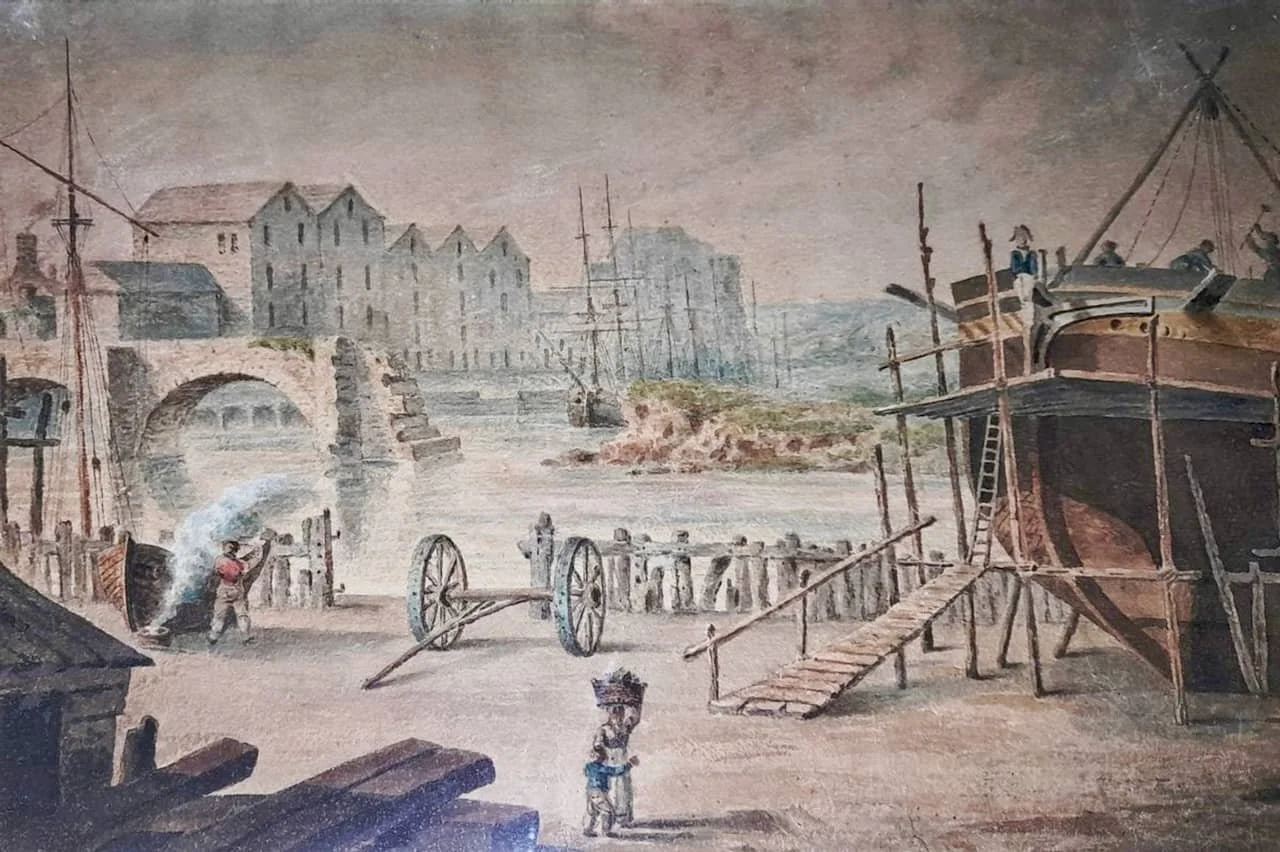
The building of the Trafalgar at Brockbank’s yard in Lancaster for William and Samuel Hinde, c1806: Courtesy Lancaster City Museums
In June, July, and September of 1818, the Lancaster Gazette published three ‘visitor lists’ of visitors to Sunderland Point. Just short columns of names tucked away in the pages. (We suspect sent to the Gazette by the landlord of the Ship Inn, when reading ‘much frequented by visitors, who have expressed themselves much pleased with the superior accommodations they met with’)
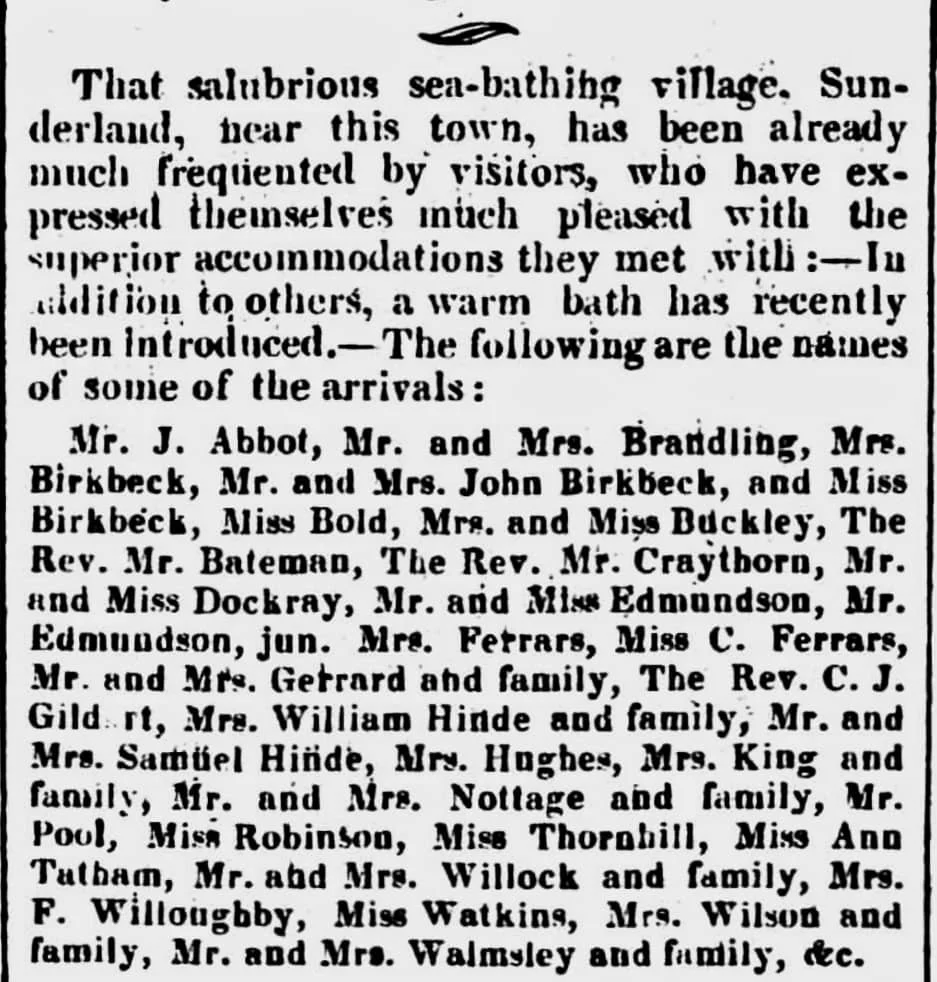
The Visitor List: Lancaster Gazette June 1818: Courtesy Guardian Newspapers
A little bit of background.
Lancaster’s ‘golden era’ in the plantation trade has ended and is in part replaced by the manufacture of textiles, oilcloth, and furniture. The centuries-old privilege of holding twice-yearly law courts for the county is under attack from the populous south of Lancashire.
1818 was a rowdy General Election year that saw John Gladstone (father of W. E. Gladstone, later Prime Minister) elected. He was one of Britain’s wealthiest enslavers and an anti-abolitionist supported by the West Indies merchants of Lancaster and Liverpool.
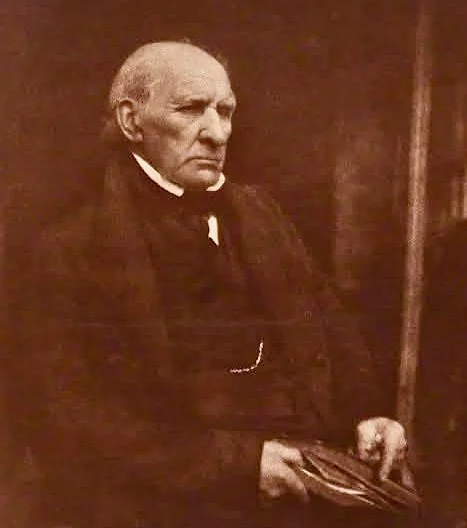
Sir John Gladstone: Photograph courtesy National Galleries of Scotland
‘Little Brighton’
Sunderland Point in 1818 was the fashionable place to be. Most of the visitors were women, their husbands left behind to conduct their business. There are 78 names on the three lists, with visits scheduled on different dates over the summer. That it was an election year may have swelled the numbers.
We knew who some of these people were, and others we have discovered, but some, absolutely nothing. It’s the best endeavour, so apologies for the errors, unfortunate guesses and the unknowns.
It is an astonishing assortment of the great and the good of Lancaster - and further afield - taking the salubrious sea air at ‘Little Brighton upon the Lune’.
They have widely different backgrounds - notably striking are the differing religious beliefs - but most fall into two general groups: The merchants and notables of Lancaster, and the minor aristocracy. The largest are the merchants, whom we will take first.
The visitor’s names are in red.
The Merchants and Notables
Mrs William Hinde & family and Mr & Mrs Samuel Hinde,
William and Samuel Hinde were the younger sons of Thomas Hinde, the leading trader and investor in enslaved Africans in Lancaster. The family had long-standing property links to Sunderland Point, owning an estate of land, essentially where Sunderland Brows farm is today (sold in 1811 to Thomas Higgin, also on the list).
The Hinde family had a close business relationship with Samuel Simpson, who owned, and after his death, his children, most of the property on the Point, until 1818. The two families were regular visitors to the Point, appearing on earlier visitor lists.
Like many Lancaster West Indies traders, they, along with their older brother Thomas, had moved to Liverpool, investing in ships and importing sugar and coffee. Their other brother, John, was a merchant working in Jamaica. William and Samuel continued commercial and property interests in Lancaster, and by 1818, following the collapse of the West Indies trade, they had returned to the town.
Thomas was one of the first traders to diversify when he rebuilt the Dolphinholme worsted textile mill in 1795. The earlier and abandoned Mill had been built by Thomas Edmondson, also on this visitor list.
Thomas was declared bankrupt in 1811, and Samuel and William, who were already investors in the Mill, became the principal owners.
In 1817, Samuel married Mary Baxendale in Lancaster Priory. Their primary residence is in Dolphinholme. Samuel also served as a Land Tax commissioner and died in 1840, leaving a substantial estate.
William, who lived close by at Ellel Hall, also took part in civic affairs and served as Deputy Lieutenant and a Justice of the Peace for the county.
In 1829, William and his unmarried sister Anne completed the purchase of Hall End House (number 22), which Anne used as a summer residence. Her primary home was a fashionable property which the family owned in Dalton Square, Lancaster.
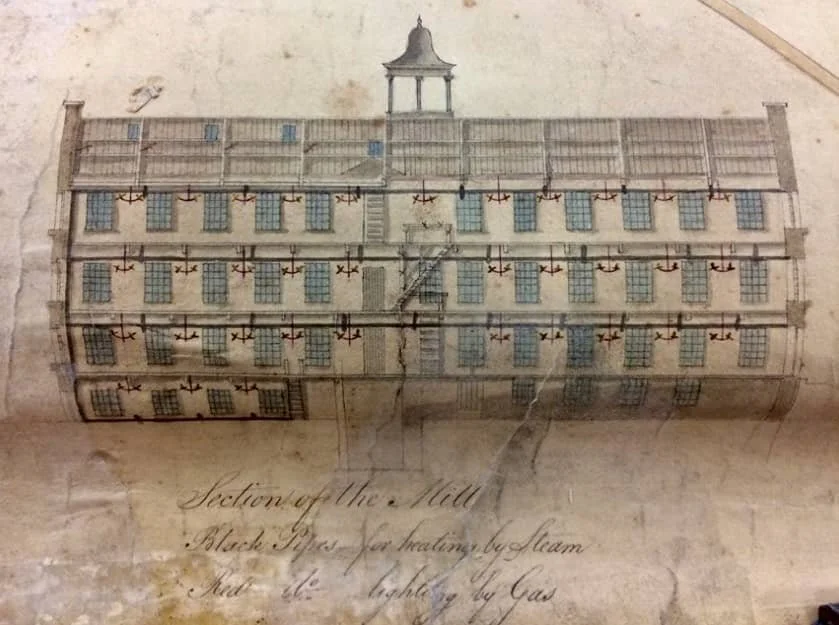
Dolphinholme Worsted Mill in 1811, drawing of the gas lighting system, one of the first in the country to be installed. Owners included the Hinde brothers: courtesy Lancaster City Museums.
Mr J. Abbot
Possibly J Abbott, a merchant of Liverpool and Lancaster. He had a coffee shipment land at Liverpool in 1806 and traded with Thomas Hinde.
Mr & Mrs Nottage & family
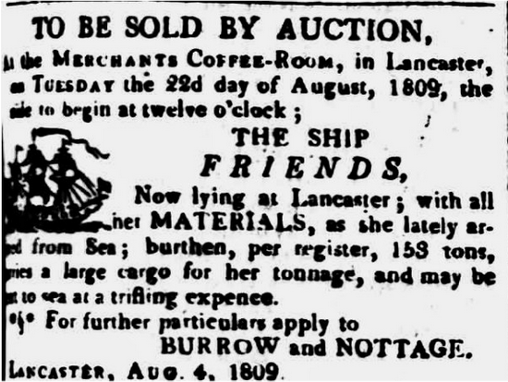
This is James Barton Nottage and his wife, Jane. He was born in Birmingham in 1786 into a Quaker family. Shortly after the early death of his father, he moved with his mother to Lancaster. By 1807, he was in partnership with the experienced George Burrow in the West Indies trade, particularly in sugar. They had an office on Market Street.
Courtesy Guardian Newspapers
Throughout the 1810s and ’20s, the firm placed frequent auction notices in the Lancaster Gazette, offering sugar imports from the islands of St. Croix and Tortuga.
In addition to owning and having ships built by Brockbank’s in Lancaster, they also owned sugar plantations in the Virgin Islands. The partners received substantial compensation for the loss of the enslaved Africans they owned following the Slavery Abolition Act of 1833.
James owned what is today number 7, and in the garden, grew the giant red cabbage noticed in the Lancaster Gazette in 1822. (see our story ‘James and the Giant Red Cabbage’)
James was elected Mayor of Lancaster in October 1822 and served as a Justice of the Peace. James and Jane had six children, two of whom died in childbirth. In 1841, they were living in Caton, where he died in February 1845.
Mr & Mrs Willock & family
Almost certainly Richard Willock, a brewer and porter merchant in Lancaster. Importantly, he was one of the two bailiffs listed on the formal announcement of the General Election. It was their responsibility to ensure the election was conducted legally and fairly. A position of power and often abused privilege, which could affect the result of the election.
It was Richard who organised the field guns to be fired on First Terrace as part of the birthday celebrations for King George the Third in that year.
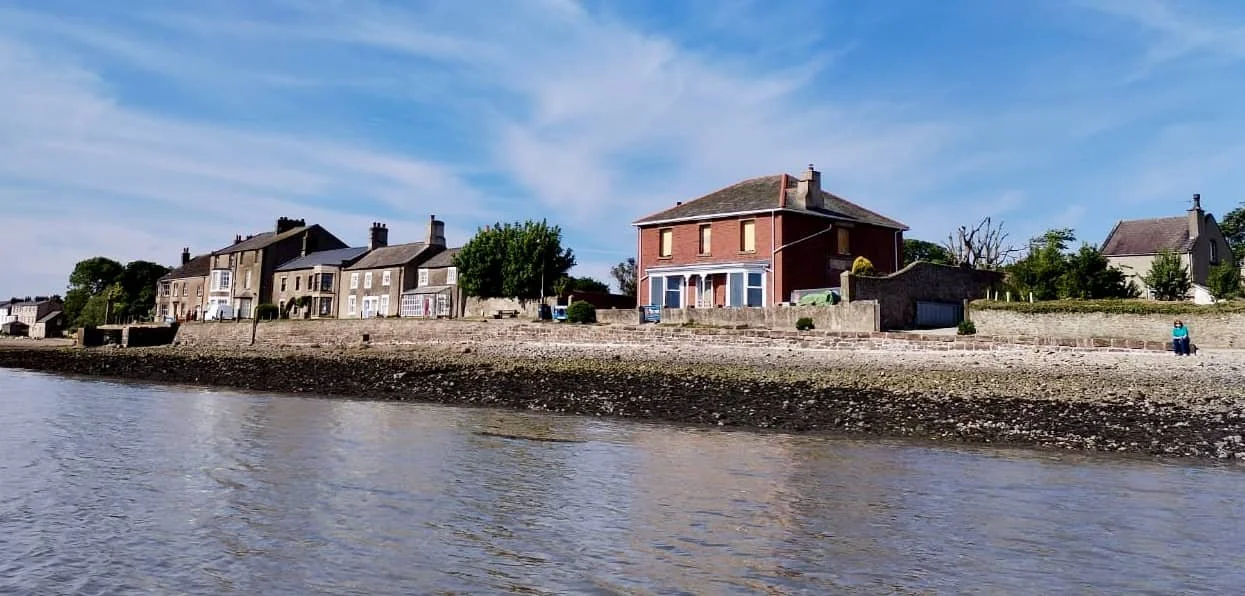
First Terrace from the River: Photo Philip Smith
Mr Dilworth, Mr and Miss Dilworth (two entries)
Members of the second and third generations of the Quaker Dilworth family, which had been deeply involved in the West Indies trade, including enslaved Africans. They had marriage connections with leading Quaker merchant families, including the Towsons, Rawlingsons, and Satterthwaits. This could be the family of John Dilworth (1745–1830), who had become a leading banker in the town.
Mrs James Moore
Probably the wife of James Moore, a prominent merchant involved in the West Indies trade and a civic leader. He served as mayor of Lancaster in 1798, 1808, and 1810. James Moore & Co. owned the ship Pusey Hall, built at Brockbank’s shipyard in Lancaster in 1808 for the Jamaica trade.
Mr & Mrs G Crossfield & family, Mr and Mrs J Crosfield and family
These are the families of George Crossfield and his son James. They were prominent Quaker merchants and industrialists in the Lancaster district. George had moved to the town in 1799 to take advantage of the West Indies trade and developed a sugar-importing and refining business.
The Gazette reports this in 1801: About 10pm last night, a dreadful fire broke out on the Green Area in this town, belonging to George Crossfield & Co, which entirely consumed the same with a large quantity of sugar.
James Crossfield continued the family’s sugar business until its closure in 1834. He later partnered with his brother Joseph in a chemical manufacturing enterprise in St. Helens.
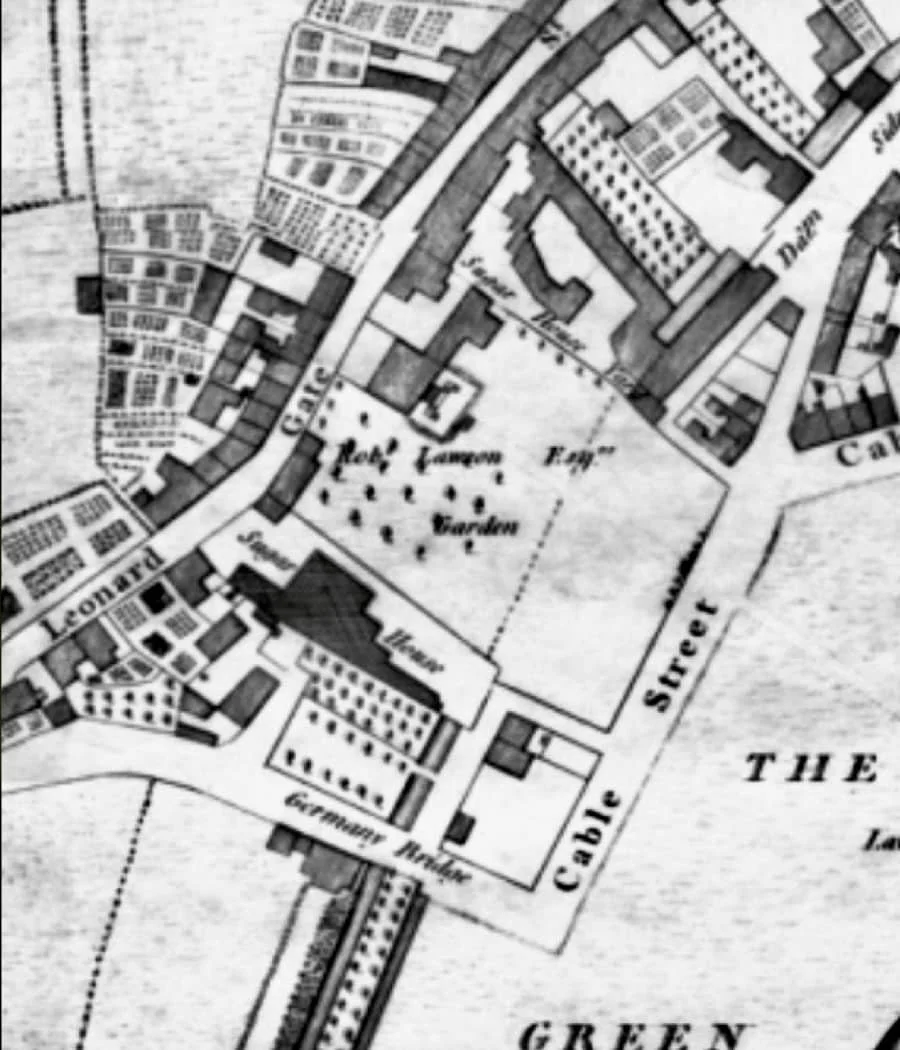
Extract from Mackreth’s 1778 map showing the ‘second’ Sugar House (lower left just off Leonard Gate) run by George Crossfield and Co from the late 1820s to 1834. Courtesy Lancaster City Council
Mr and Mrs G Burrow
George Burrow, the business partner of James B. Nottage, was also a visitor in 1818.
The partnership was founded in 1807, and it owned sugar plantations in the West Indies, as well as engaged in sugar trading. One of the boats they owned was the ‘George Burrow’, which was tragically wrecked in the Lune estuary in 1833. After the business partnership dissolved, George was imprisoned for debt in bankruptcy.
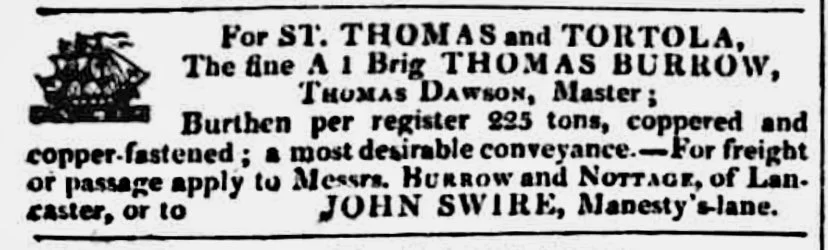
Notice for the sailing of the Thomas Burrow Gore's Liverpool General Advertiser - Thursday 04 September 1828
George was Mayor of Lancaster in 1828, 1833 and 1835/6.
Miss Bold
It’s just possible she could be Elizabeth, known as Betty, one of the daughters of Jonas Bold. He was a banker, sugar merchant, and an investor in the trade of enslaved Africans. He would have been well known to Samuel Simpson and the Hinde families. Jonas was the Lord Mayor of Liverpool in 1802 and died in 1822. Betty would have been 48 in 1818.
Mr. & Mrs John Birkbeck and Miss Birkbeck.
Probably John Birkbeck with his wife and daughter, Esther. A Quaker family from Settle, Yorkshire. John was initially a draper, whose business eventually expanded into banking. The Quaker connection links him in business with the Rawlingson family.
If the daughter is Esther, she would have been 35 years old and, in February 1824, married Quaker Joseph Dockray, who was also a visitor in 1818. Was this their first meeting…!
Mr and Miss Dockray, and later in the year, Mr D Dockray, Mr B Dockray,
The Quaker Dockray family, with roots in Manchester, were an influential merchant family in Lancaster. David Dockray, senior, married Esther Dilworth (above) in 1772, establishing marital links with other important Quaker families.
In addition to their trade with the West Indies, they held interests in textile manufacturing and trade, and the import of wines and spirits. For a time, they were involved with the Halton Iron Company.
Mr D. Dockray and Mr B. Dockray could be brothers, David Junior, born 1778, and Benjamin, born 1786.
The family were involved in social reform, and Benjamin was a member of the Town Council between 1839 and 1848.
Mrs and Mrs W Thompson and family.
Almost certainly, William Thomson was a merchant who, with his brother John, owned 8 & 9 Dalton Square in Lancaster (James Burrow and the Hindes also owned property there). John appears as a part-owner of Hall End House (number 22) in 1803.
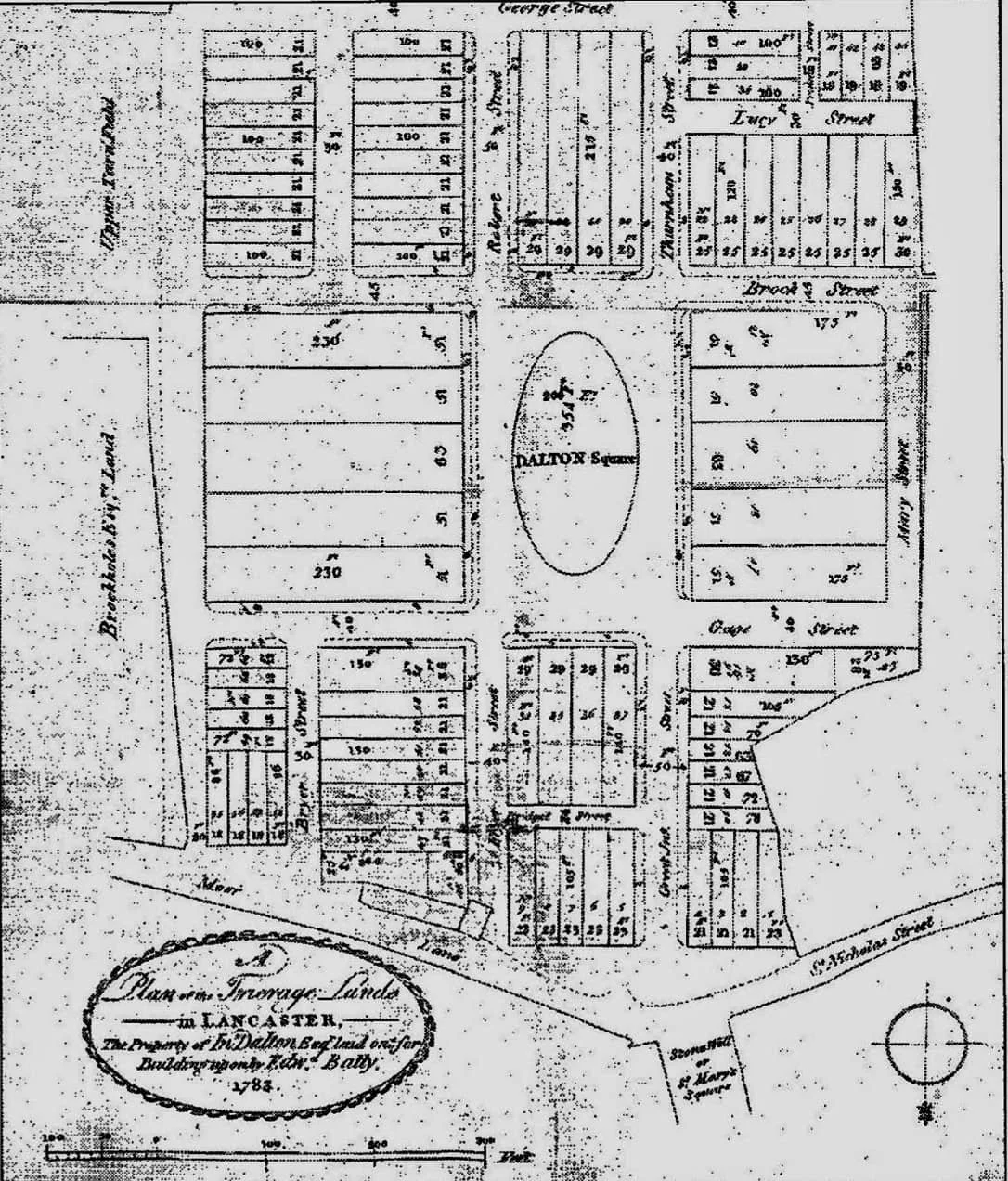
John Dalton’s original plan for the roads and building plots, 1783. (Source: White A (2003) Lancaster: a History).
Mr & Mrs Walmsley & family
We are confident that these are Jeremiah and Ellen Walmsley, married in 1813, who were regular visitors to the Point.
Jeremiah was a wealthy corn merchant in Lancaster. They lived on St. Leonard's Gate in 1818. Later, they moved to 10 Penny Street. He died in 1839, but we find Ellen and her younger daughters as summer visitors at number 16 in 1841, and next door at 17 is her eldest son, William, aged 25, and his wife, Agnes, with two servants.
Mr & Miss Edmondson, Mr Edmondson jun.
This is Thomas, with children Jenny and John, Edmondson, who were frequent visitors to the Point. Thomas bought the Old Hall (number 21) in 1818 and used it as a summer residence. After his death, it passed to Jenny, who continued to use the property until she died in 1862
Thomas was a manufacturer of woollen textiles; his principal home was Grass Yard Hall in Caton. Evidence suggests he is linked to the Hinde brothers through their ownership of the Dolphinholme textile mill.
Thomas was one of the stewards of the 1829 Regatta at SP.
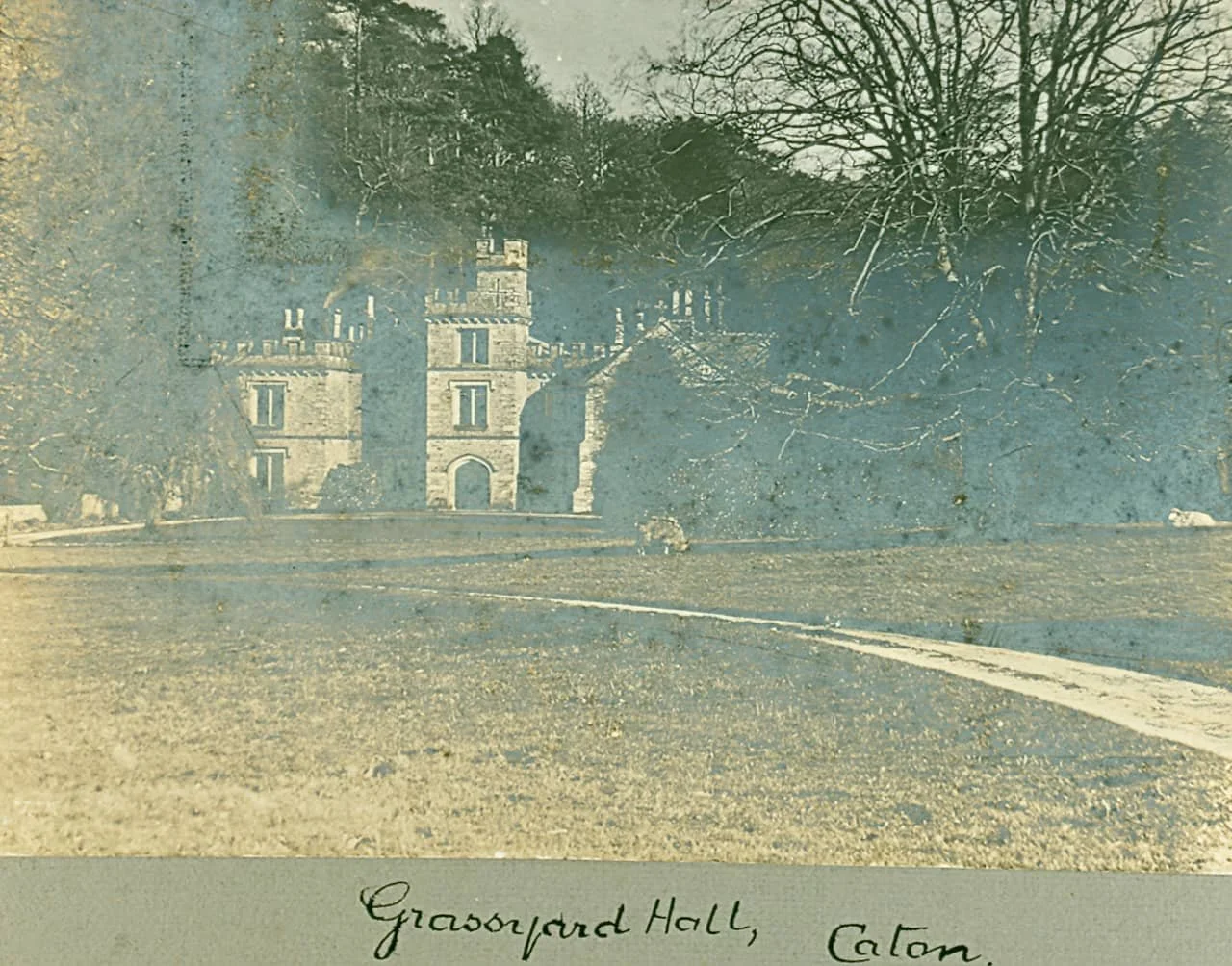
Grassyard Hall, Caton, home of Thomas Edmundson. A Sam Thompson photo: Red Rose collection, Lancashire County Council
Mr & Mrs T Higgin and family
Most likely Thomas Higgin (senior), who was for many years Governor of Lancaster Castle Gaol. He owned the land at Sunderland Brows farm, bought from the bankrupt Thomas Hinde (junior) in 1811.
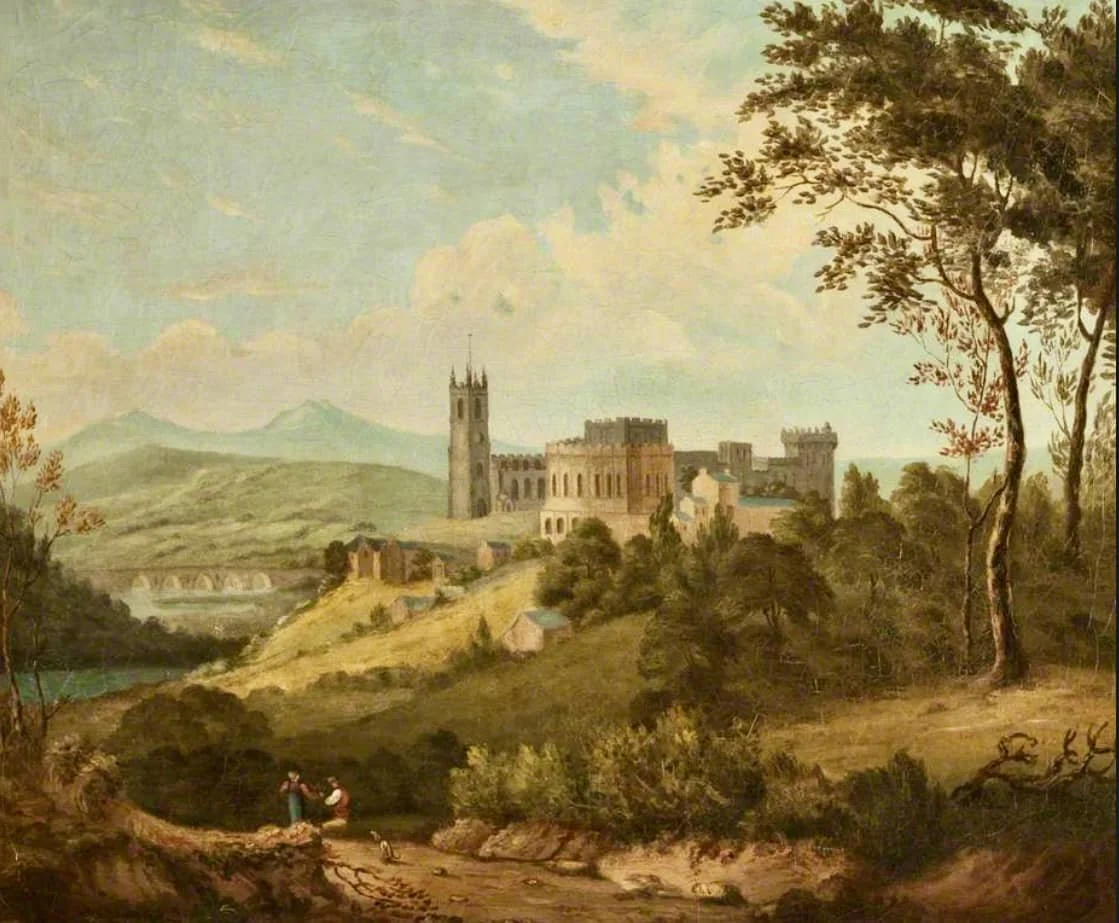
View of Lancaster Castle by John Letherbarrow, 1822: By permission of the Chancellor and Council of the duchy of Lancaster
Mrs Wilson & family
It seems possible this could be Ellen, the wife of John Taylor Wilson, who was a solicitor and served as Mayor of Lancaster in 1807, 1816, and 1826. He was involved in several legal practices and might be the Wilson of Wilson and Higgin, the solicitors involved in the auction sale of the Simpson properties in 1816 and 1817.
(Essential note: there were many Wilsons and Higgins!)
Mrs Harrison
Mrs Strethill (Henrietta) Harrison was a prominent Lancaster socialite and philanthropist. She served at the Point as the Patroness of the archery contest in 1820 and the regatta in 1829. It is plausible that she was the tenant of the Big House (where the Reading Room is) after Mrs Willoughby’s death.
Born in 1774, Henrietta Saul was the daughter and heiress of the wealthy Lancaster merchant Thomas Saul. She first married the Rev John Alexander Hunter in York in 1796. Sadly, he died in 1798 at the age of just 29 while serving in the church in Bath. With two young children, she returned to Lancaster.
In 1811, she married Strethill Harrison, a lawyer who had moved to Lancaster from Cheshire. They lived in considerable style in a large house on the High Street. She raised funds for numerous good causes, including people experiencing poverty, for schools and the theatre. Strethill died in 1823.
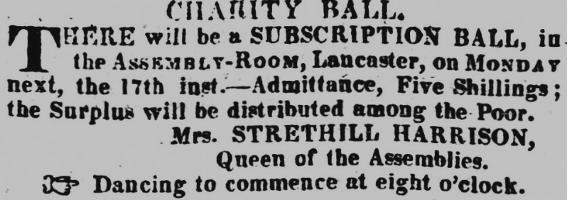
Charity Ball Lancaster Gazette Feb 1817: Courtesy Guardian Newspapers
Her daughter Jane Hunter, at 19, married Charles Gibson Jr., heir to one of Lancaster’s largest estates, Quernmore Park.
Her son, John Alexander Hunter, like his father, became a member of the clergy and served as Chaplain to the British Ambassador in Paris. He married Patricia Barrington, daughter of a high court judge of the admiralty in Ireland. The couple was well-travelled and may have shared the Big House with Mrs Harrison. They were listed as the occupants when leaving the house in 1836
At the 1829 Regatta, besides being Patroness, her son and son-in-law were among the stewards. Her son John’s yacht, the Red Rover, won the primary race amid controversy.
Mrs Harrison died at the age of 75 in 1849. An obituary window in her memory was installed at St Mary’s, Lancaster.
Mrs Baxendale and Miss Baxendale
Almost certainly, this is Mabella Baxendale and her daughter, also named Mabella. She was the wife of Josiah Baxendale, one of the best-known surgeons in Lancaster. They were married in 1774. She was the daughter of Thomas Salisbury of Settle and directly related to Thomas W. Salisbury, mayor of Lancaster in 1818/19.
The Baxendales lived on Castle Hill, just a stone's throw from one of the homes owned by the Hindes. Their eldest daughter, Mary Baxendale, married Samuel Hinde in 1817.
Their son Joseph would become a managing partner of Pickfords & Co, the nationally known carriers and haulage firm, later better known as movers of household possessions during relocations.
Mr Batty
We would like to think that this is Edward Batty, a trusted member of the Lancaster community, who is also the owner of a house in Dalton Square. If true, he is the grandson of Edward Batty, who died after falling from a window of the house when reaching out too far to check the time on the town hall clock!
Mr Webster
Possibly John Webster, stone mason, marble merchant and builder, associated with the noted architect Thomas Harrison, who completed several works in the town, including extensive repairs to Lancaster Castle and Skerton Bridge. Would have been well known to Thomas Higgin, listed above.
Mr and Mrs Langshaw and family
Probably the wife and children of John Langshaw, who was born in London in 1763 and served as the organist at Lancaster Priory Church. He was also a music teacher and an assistant to his father, John Langshaw, a renowned organ builder. As an organist, he would have been well known to the Rev. John Manby, vicar at the Priory and a frequent visitor to the Point.
(Note: there is also a record of William Langshaw, a surgeon associated with Lancaster Castle, and he would have been well known to Thomas Higgin, but we choose the musician as our best guess)
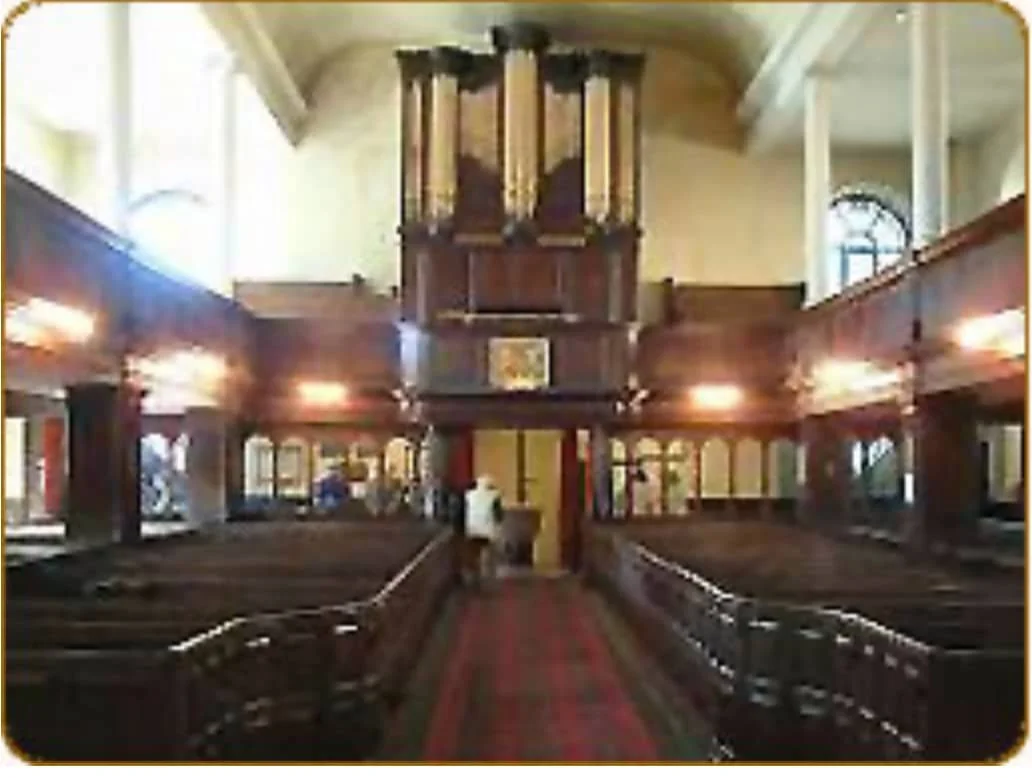
The Langshaw Organ, St. John's church, Lancaster. Built by John Langshaw and his son and opened in January 1785.
Miss Ann Tatham
Ann would be only 16 in 1818, and with no parents mentioned, it raises doubts about whether this is her, but strong circumstantial evidence suggests it is her.
Ann was born in 1802, the daughter of Thomas Tatham and his wife Ann. Thomas was a noted mariner and spirits merchant. He served in the Royal Navy and captained HMS Penelope in the Caribbean during the war with revolutionary France.
He was the captain of Thetis, a West Indiaman sailing from Lancaster. This notice follows (probably) his final voyage.
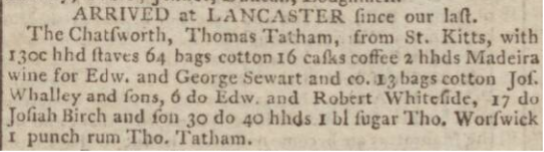
Lancaster Gazette, July 1804: Courtesy Guardian Newspapers
Thomas died in 1805 at the age of 49. ‘His Integrity of heart and benevolent disposition will long be remembered by all who knew him, who will much deservedly lament his loss’ (Lancaster Gazette, Nov 1805)
It seems inevitable that Thomas will have been well known to the Hinde and Simpson families, and Ann would have been friends with their daughters.
In March 1821, Ann was married to Thomas Eskrigge, a merchant of Lancaster, in St. Mary's Church, Lancaster.
Mr Barrow
Possibly could be James Barrow, the son of Dr William Barrow, one of the first purchasers in the Dalton Square development.
2 Miss Atkinsons,
There was a J. Atkinson active in Lancaster, who was the surveyor for the Edward Baines map of Lancaster of 1824. It’s just possible they could be related.
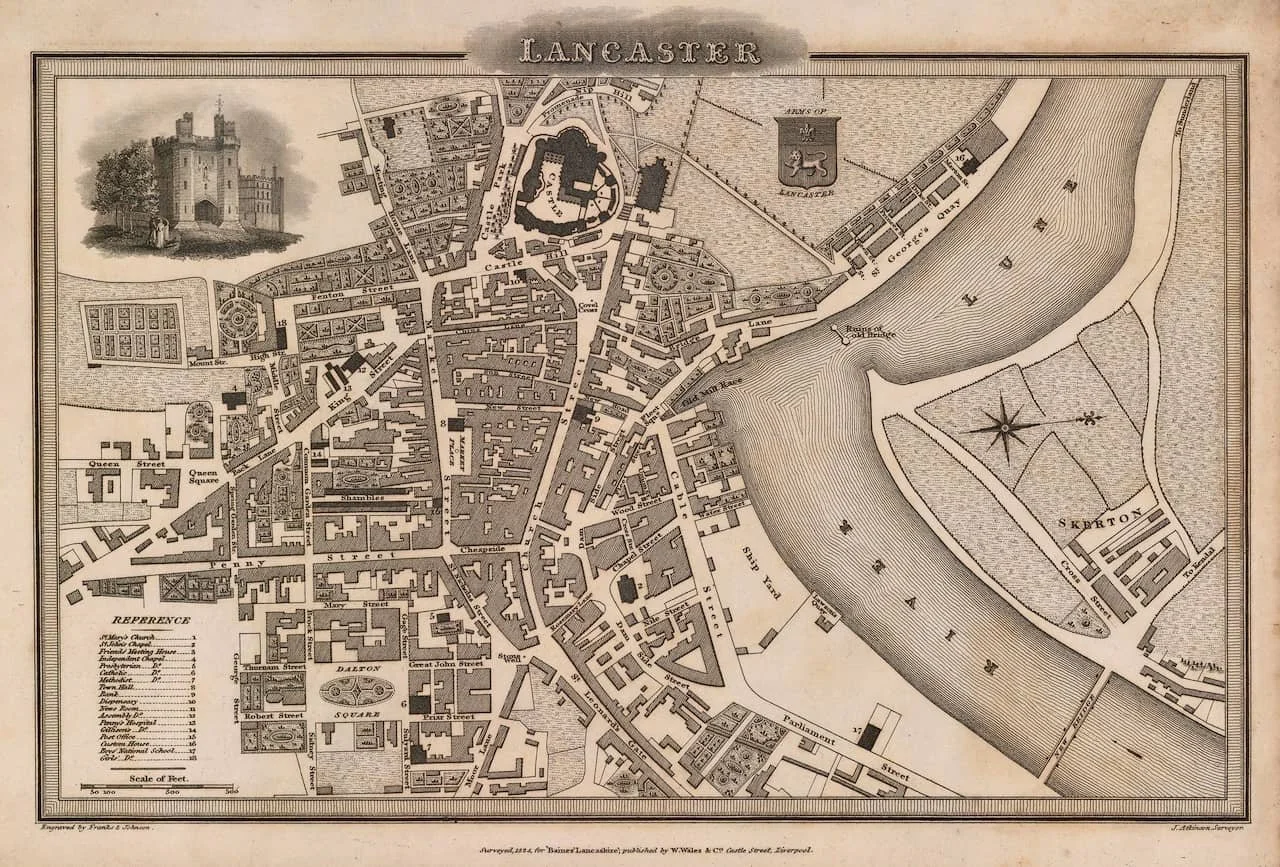
Edward Baines’ map of Lancaster 1824: Courtesy Lancaster University
The Minor Aristocracy
Mrs Francis Willoughby
A wealthy and influential woman who has inherited a substantial fortune. She resides in Derbyshire at Higham Cliff House and is related by marriage to the Ferrers and Gerard families, prominent estate owners in the Midlands and northern England.
Our earliest record of Mrs Willoughby is a visit to SP in 1814, possibly for health reasons, but as likely to check on the property she may have inherited. By 1817, she had purchased the ‘Big House’, believed to have been built by Joshua Lawson in 1715, which is now the site of the Reading Room and maisonettes.
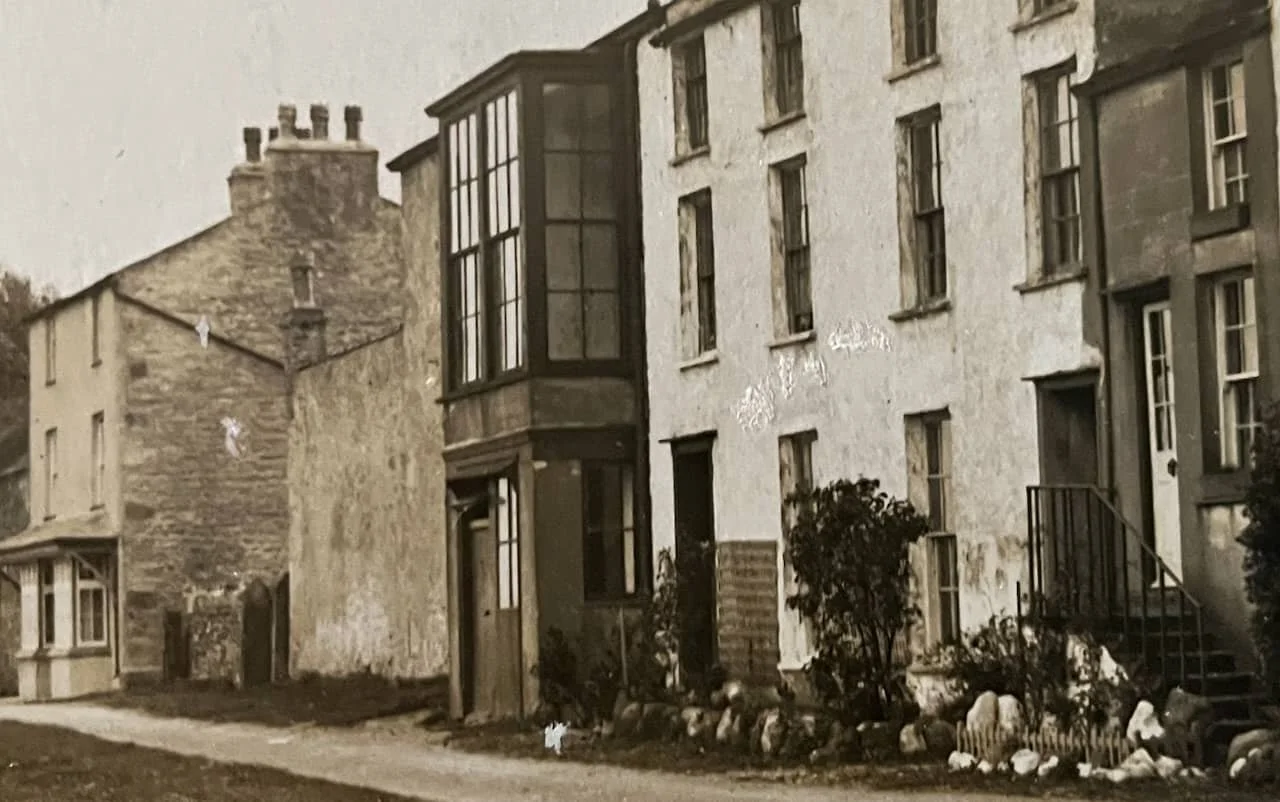
The ‘Big House’ on Second Terrace c 1930s with the imposing entrance, which may date from Mrs Willoughby’s ownership: From the collection of Hugh Cunliffe.
She acquired much of he property on Second Terrace. On her death in 1821, all the land and properties from the start of the Terrace, now numbered 13 to 20 (Cotton Tree Cottage), belonged to her.
Mr Siddall
Possibly, William Siddall (1827–1829), a gentleman and solicitor to Mrs Willoughby, was the primary executor of her will. He resided at Hallfield Grange in the parish of Shirland, a short walk from Higham Cliff House, Mrs Willoughby’s home.
Perhaps he accompanies Mrs Willoughby to provide legal advice on her property purchase at the Point.
Mrs Ferrars and Miss C Ferrars
The relationships between the Willoughby, Ferrers, and Gerard families is complicated.
We believe Mrs Ferrers is Helena, the wife of Edward Ferrers, with her daughter, Catharine. It is this Catharine with her sister's husband, John Bruno Bowdon, who inherited the Sunderland Point property of Mrs Willoughby.
The sister of Edward Ferrer, Elizabeth Ferrers, married John Gerard in 1802. (see next entry)
The Ferrers family was a prominent Anglo-Norman lineage with considerable estates in Derbyshire and Leicestershire, including Tutbury Castle. Their influence was centred in the Midlands.
Mr & Mrs Gerrard & family
The name is probably misspelt, and it is Gerard. It would fit the profile of these visitors if this were John and Elizabeth (nee Ferrers, sister of Edward) Gerard. They have arrived as a large family group, bringing two Roman Catholic priests.
The Rev. Mr Craythorn.
This is the Rev Mr Francis Craythorne (the spelling varies), who was the personal Roman Catholic priest of Colonel William Gerard, John’s brother, who resided at Garswood House, near St Helens.
His life ended in a tragic drowning accident when he lost his life at Southport in 1822. Also drowned was John Gerard, the husband of Elizabeth, nee Ferrers, mentioned above.
(Garswood is three miles from Blackbrook, which was the home and direct link to the Rev. Joseph Orrell, next on the list.)
His death was a profound loss to the local community, as reported by the Westmorland Gazette.
‘The Rev Mr Craythorne was a Roman Catholic clergyman eminent for his extensive benevolence. His loss will be deeply felt by people experiencing poverty of the surrounding country, to whom he was in the habit of administering medical aid, gratuitously, with extraordinary success.’
Rev Joseph Orrell.
Rev. Joseph Orrell was a significant Roman Catholic clergyman. He was educated in France and ordained as a Catholic priest in the 1770s, spending most of his career serving missions in Lancashire. Until 1814, Fr. Joseph Orrell was the Catholic mission priest at Singleton (near Blackpool) in the Fylde district.
In 1818, he was based in Blackbrook (near St Helens, close to Liverpool), where the Orrell family supported a private Catholic chapel. Blackbrook is situated near Garswood Hall, the home of William Gerard. (His brother John Gerard married Elizabeth Ferrers in 1802, which links us to the Ferrers family and Mrs Willoughby.)
Others from further afield
The Rev. Mr Bateman
Possibly Thomas Bateman, a key figure in the early Liverpool Primitive Methodist Church. Initially from the Potteries in Staffordshire, he appears to have spent much of his early religious life in the Preston area.
He was sent to Liverpool to attempt to establish a formal grouping. He would hold outdoor sermons, as well as in rented rooms, to preach to the predominantly working-class population of Liverpool.
The title “Rev.” for Bateman is used loosely. In that period, Primitive Methodist preachers were usually lay ministers rather than ordained clergy. Nonetheless, later writings sometimes refer to him as Rev. Thomas Bateman in recognition of his service.
Rev C J Gildart
He is identified as the Rev James (C.J.) Gildart was a Liverpool-born clergyman who served as a curate and later vicar of the town’s main Anglican church for a decade. James was the grandson of Richard Gildart, an 18th-century Mayor of Liverpool and a slave trader, which links to Liverpool’s civic elite. It would have been known to the Hinde brothers.
As his prestige within the Anglican Church grew, he was appointed the Rector of High Wycombe in Buckinghamshire, holding that benefice while still serving as a vicar in Liverpool. In 1818, Rev. James (C.J.) Gildart was in his late 30s and splitting his time between Liverpool and High Wycombe. He died four years later, in 1822, at the age of 43.
The rest of the names on the lists
Finally, these are the names on the visitor lists who are unknown; we have leads and faint clues, but they are insufficient to suggest an identification. We would welcome any suggestions as to who these other people are.
Mr. and Mrs. Brandling, Mrs. and Miss Buckley, Mrs. King and family, Mr. Pool, Miss Robinson, Miss Thornhill, Miss Watkins, Mr. and three Miss Margerusons — with no close spelling errors — Mr. and Miss Taylor, Miss Shore, Mr. Watkin, two Miss Albrights, Mr. Robert Gardner and family, Mr. and Mrs. T. Bolland and family (possibly a solicitor known to Mrs. Harrison), Mr. Charles Parker and family, Miss Welch, Mr. Dewhurst and family, Mr. Latham (possibly Arthur George Latham, a Liverpool merchant), and Mr. and Mrs. Law and family (perhaps a notable from Liverpool). Mrs Hughes (There is a prominent Hughes family involved in paper making and cotton textiles in Lancashire, but we find no direct connection.)
We are grateful for the exceptional help of Beth Hampson, who tracked down the details of Mrs Harrison and Ann Tatham, and provided material on many other names.