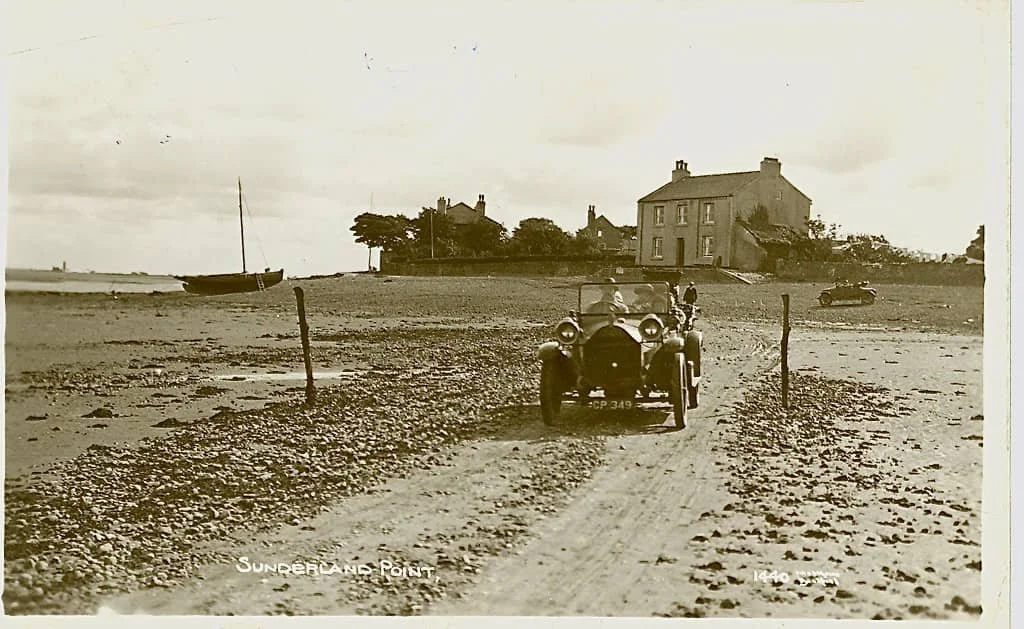
Family leaving the Point c1920s: Courtesy Red Rose collection, Lancashire County Council.
Today, we are publishing a new gallery of Sunderland Point postcards, and we are hugely grateful to all those who have contributed images. Although there are over 120 examples, we estimate that many more must have been printed, but how many, we just don’t know.
Only those intended for posting are included. Dating is difficult. Very difficult. We have assumed the same date for the photograph and publication of the card, but posting can occur much later. We know of a card posted at least 20 years after its initial publication.
Our oldest cards date back to the early 1900s, and the most recent cards are from photographs taken by Hugh Cunliffe in the 1970s.
A little bit of useful background…
Arriving in this country in 1870, the postcard was immediately adopted as a quick and inexpensive method of sending short messages. The first cards included an imprinted halfpenny stamp that covered the price of postage and was half that of a letter.

Courtesy The Postal Museum
Only a year later, in 1871, 75 million postcards had been posted.
Postcards could be written and sent quickly. It was the instant messaging of the day, with scribbled notes, such as ‘see you at 4 pm’, that could be sent in the cities and received the same morning. There were Initial doubts about the propriety of sending openly public messages (the servants could read them – heaven forbid!), but these quickly disappeared.
In 1894, the Post Office broke its monopoly and accepted privately printed postcards for delivery. Now, photos appeared on the front, initially as sales promotions, but soon featured images of sportspeople, war heroes, and even well-known politicians.
In 1902, the last innovation to the postcard we recognise today was the introduction of the ‘divided back’, where the address is written on the right and the message on the left.
This immense popularity encouraged improvements in photographic techniques, moving the photographer out of studios and to outdoor locations, most importantly, to the holiday resorts.
High-quality cards, published by increasingly sophisticated companies, encouraged usage, and by 1910, over 800 million were posted.
But not of Sunderland Point!
Sunderland Point Postcards
It’s disheartening to see these early, drab, poor-quality cards. It’s inexplicable why this should be when compared to Morecambe postcards of the same period. Like this colourful one in the early 1900s.
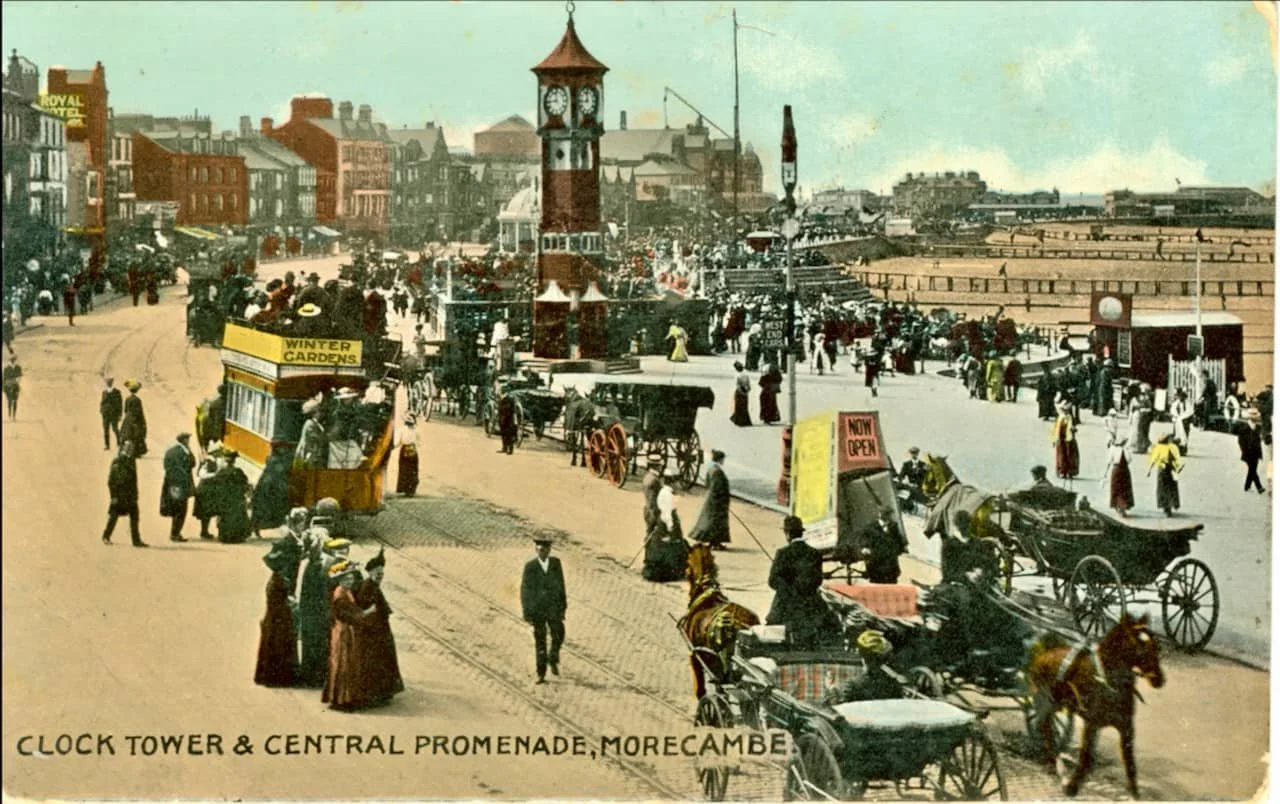
Morecambe Clock Tower Postcard c1905: Courtesy Red Rose Collection LCC.
Even into the mid-1930s, most photographs used for village cards were still in black and white.
The first cards were locally made, featuring rough handwritten labels with no indication of the publisher's or photographer's names. These two are the earliest found so far and date to c1900
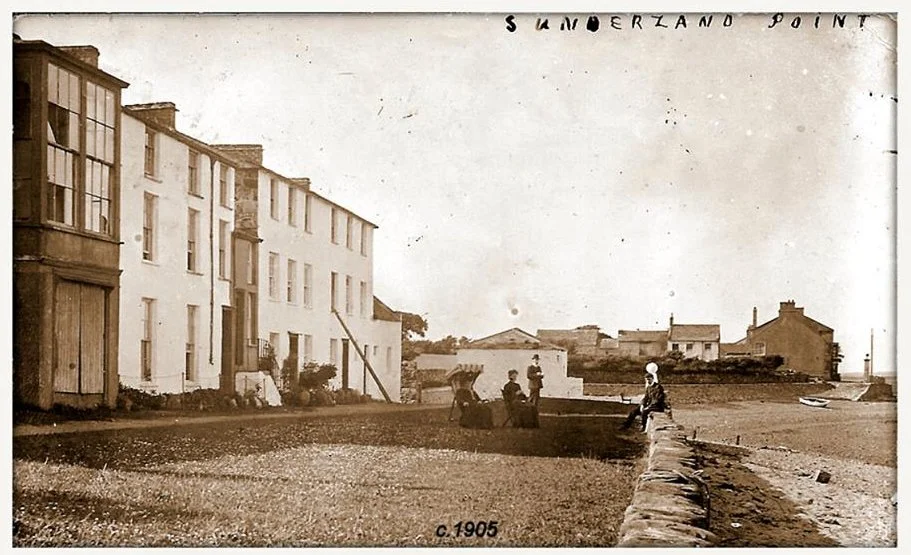
Website Collection
This image is of Second Terrace - the date stamp of 1905 has been added later. Notice Dolphin House is not yet built (1914), nor is the porch and bay window, which was added to Point Farm in 1910 (today number 14).
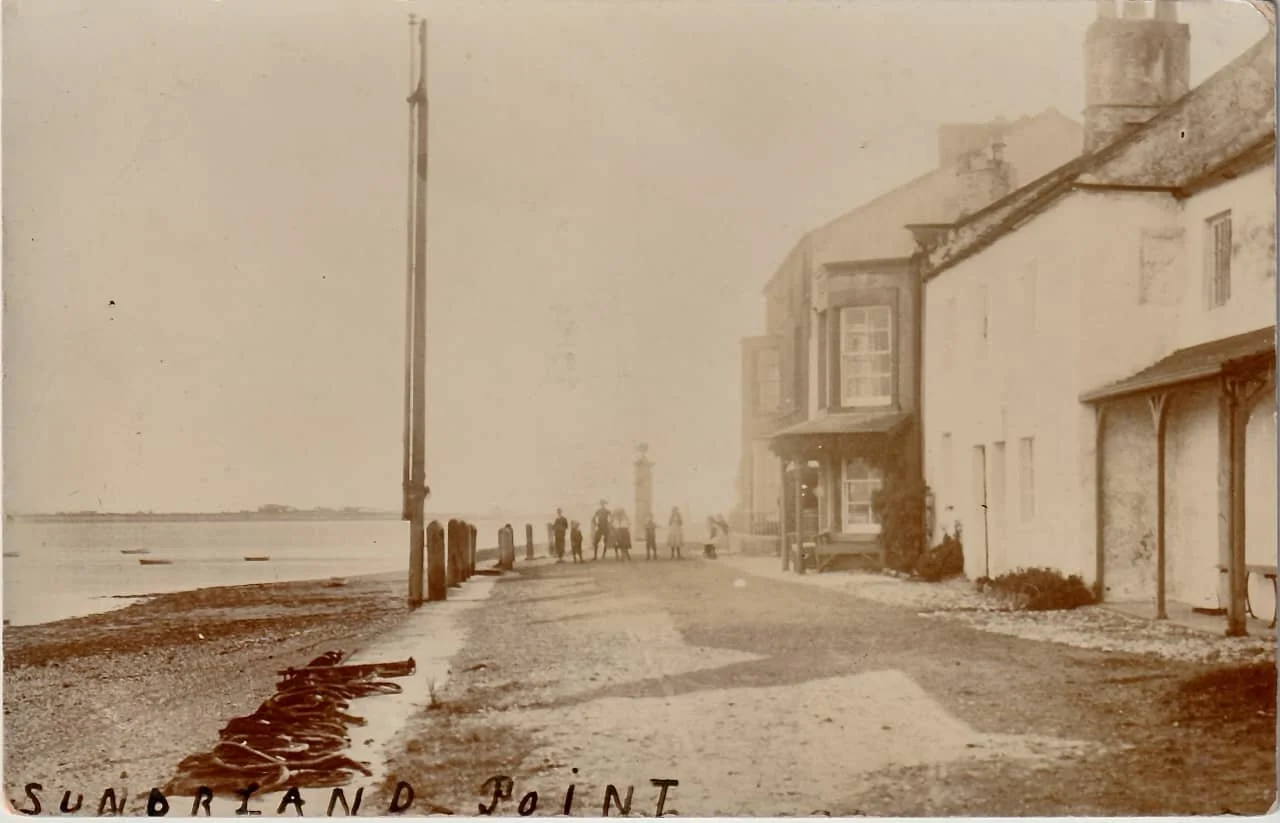
Website collection
The second, a First Terrace image, shows the canopy at the first house on the right (number 4), indicating a date later than 1900.
Notice also that the addition of ‘Sunderland Point’ is poorly written and misspelt on the card. The handwriting is identical, so it’s likely the same date.
The next two are part of a series that was published slightly later, we have one with a postmark of 1905.
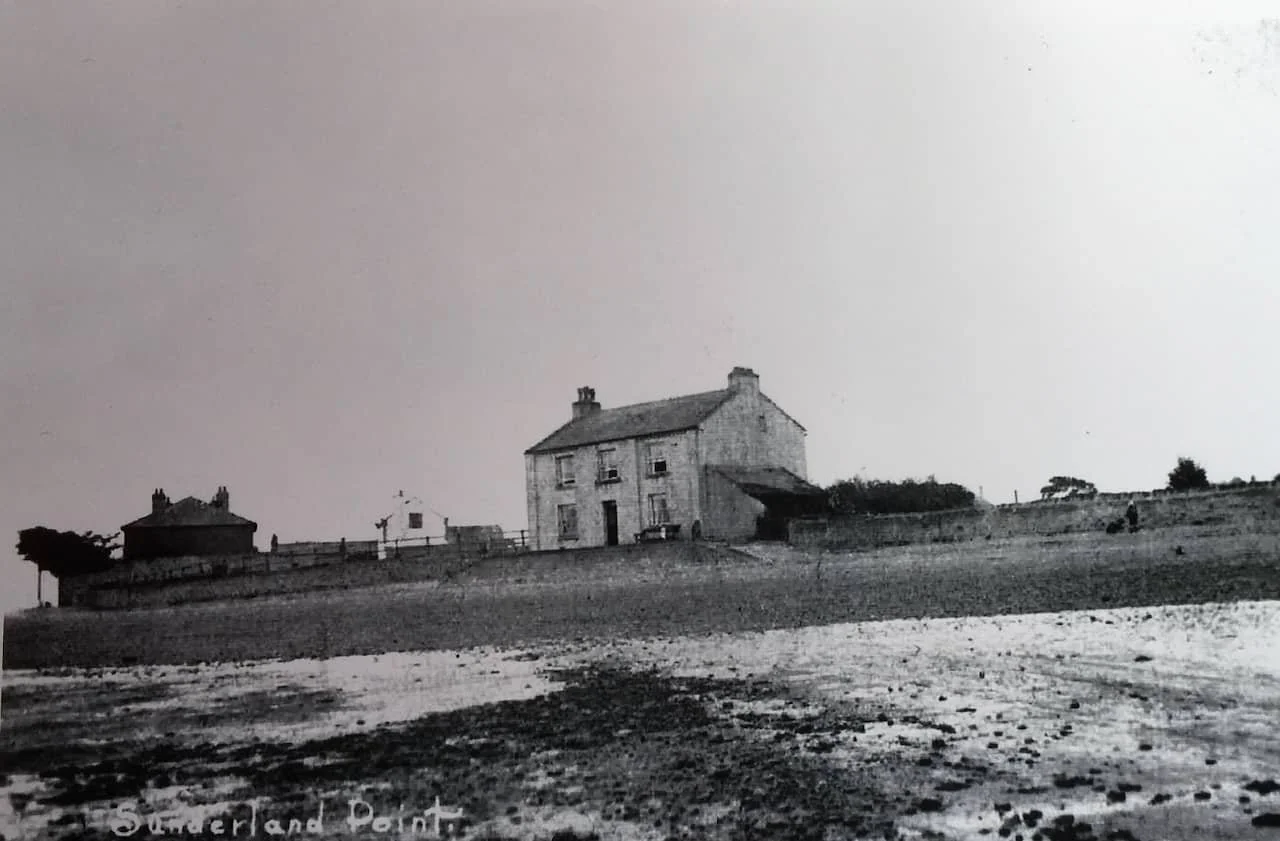
Collection Wilton Atkinson
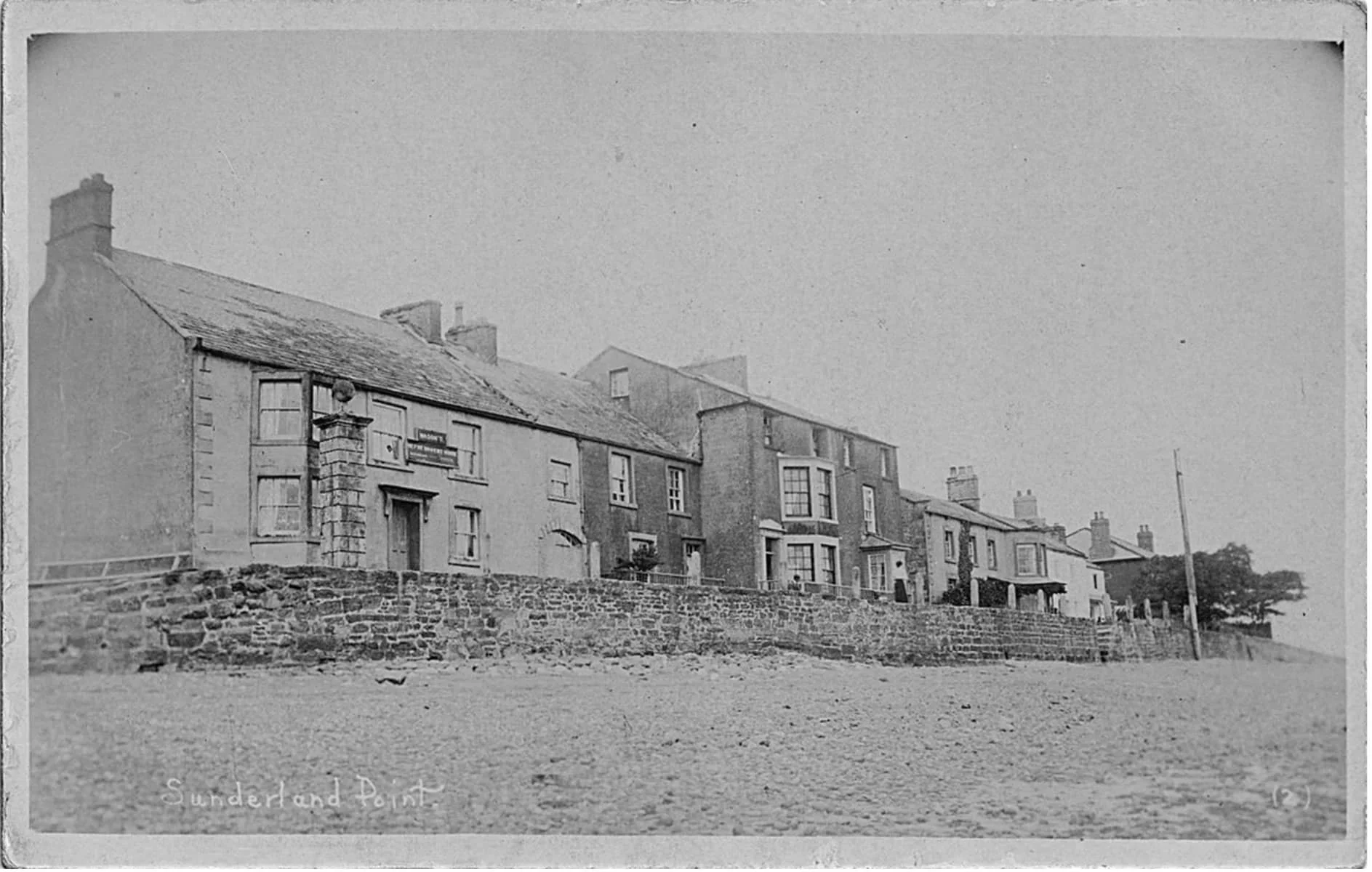
Website Collection
This writing style is in lowercase and features a distinctive wavy cross on the ‘t’, which means that wherever we spot this script on similar cards, we can apply the same date for publication. The producer of the cards has written the title directly onto the negative, which is why it appears in white.
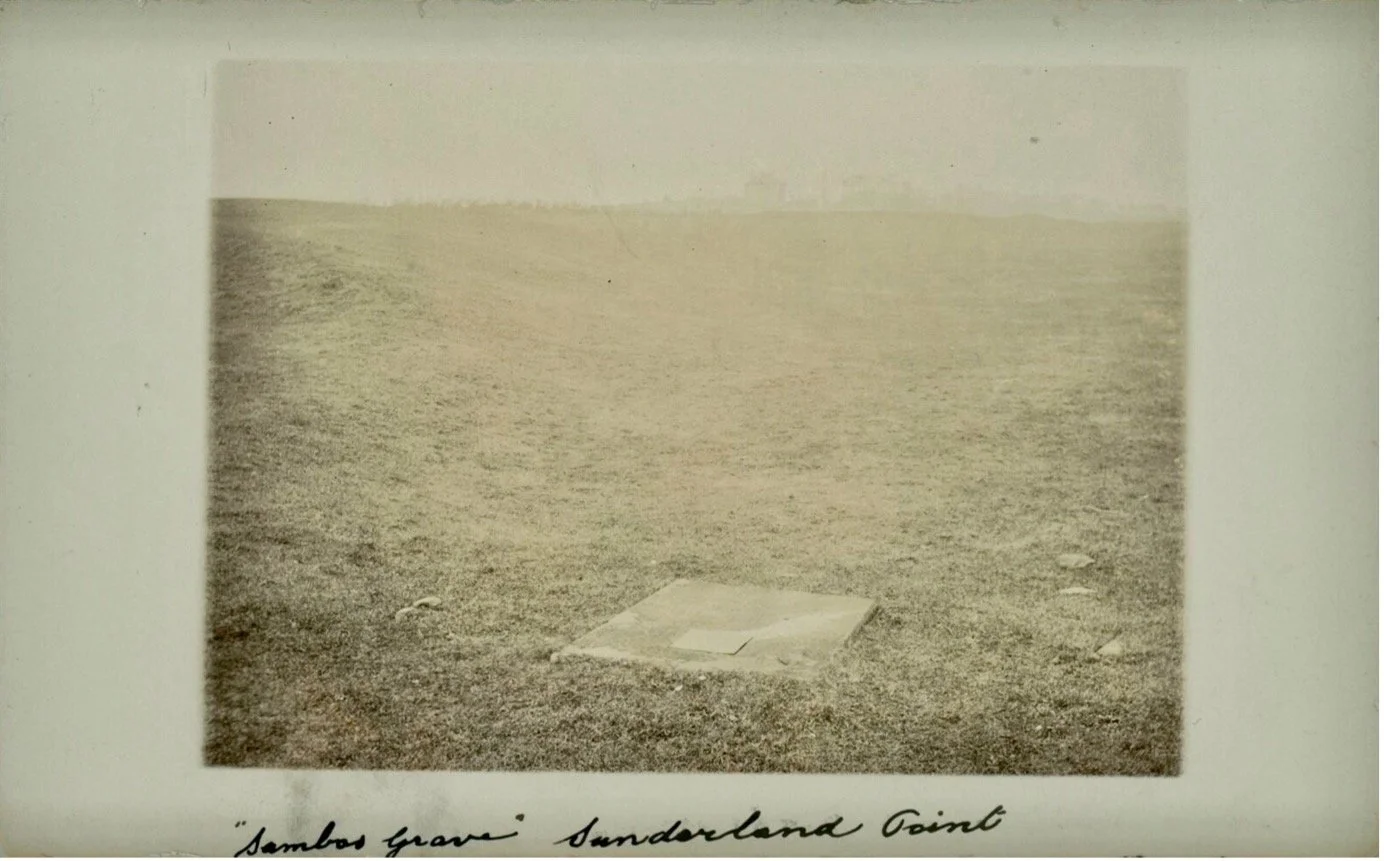
This is the earliest postcard of the gravesite yet seen, dated by a collector to circa 1910: From a Private Collection.
The next two are much easier to date.
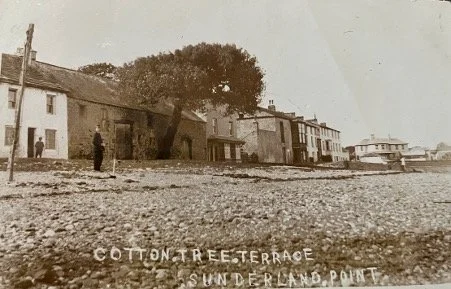
Collection Wilton Atkinson
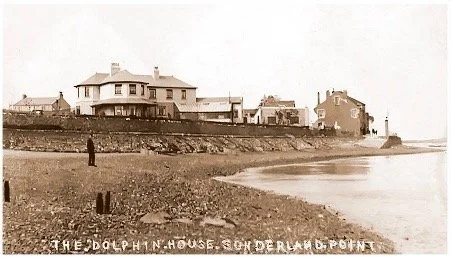
Collection Elizabeth Hampson
Both these examples feature a newly built Dolphin House, with a third card having an identical printed style and a postmark. We can date with certainty to 1914.
Roughly printed lettering is a feature of these cards.
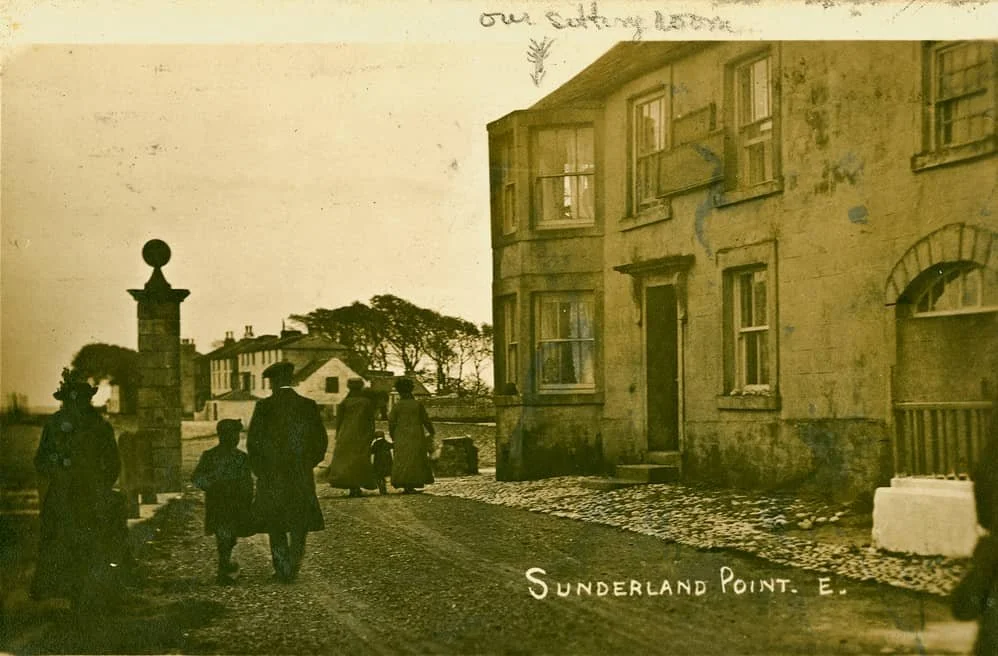
Temperance Hotel c1916: Red Rose Collection, LCC
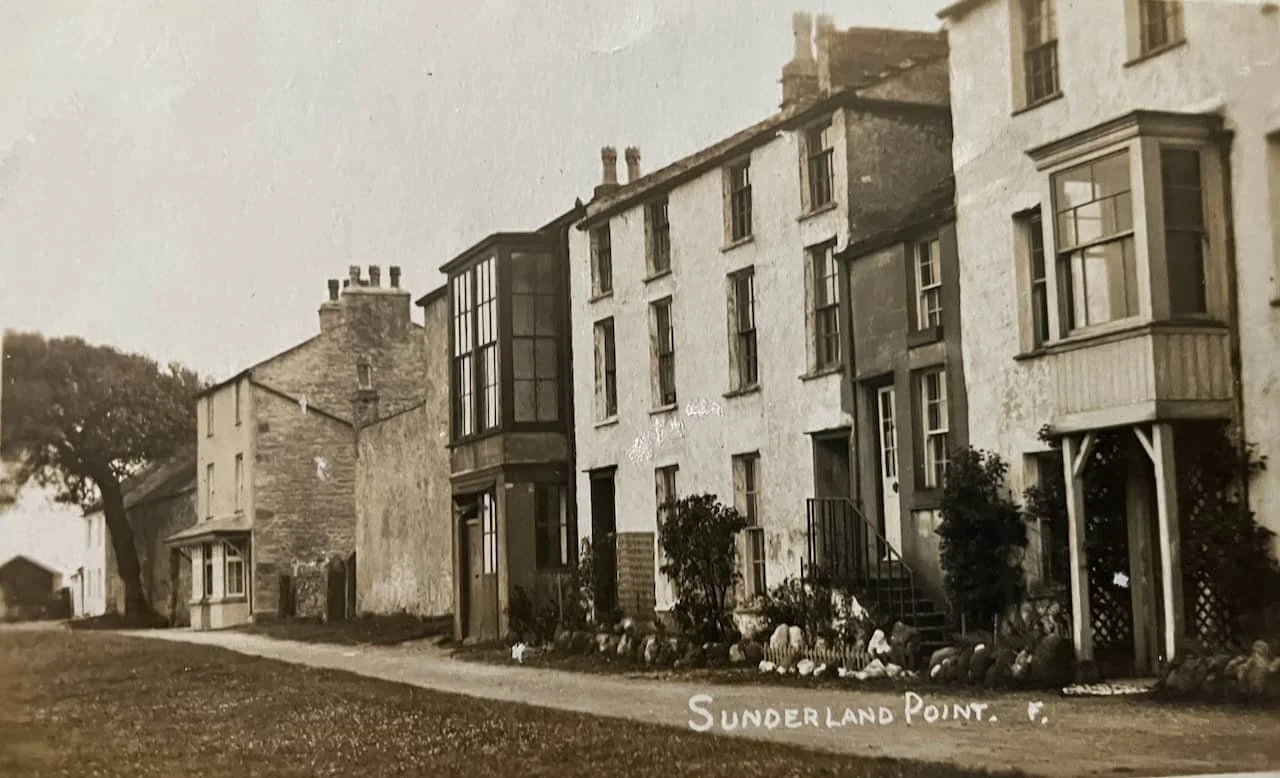
Second Terrace: Collection Hugh Cunliffe
They are part of a set; these are Sunderland Point ‘E’ and ‘F’ (we also have ‘B’ and ‘D’). The top card of the Temperance Hotel was used and postmarked in 1916. Notice on the top of the image, the writer has inscribed ‘our sitting room’—hopefully a satisfied customer. (If the set is an alphabetically numbered series, we would love to see ‘A’ and ‘C’!)
The period from 1900 to 1914 is regarded as the peak of postcard popularity in the United Kingdom. Images of Sunderland Point were mainly a memento of a brief visit here while on holiday in Morecambe.
The Seaside Holiday Postcard
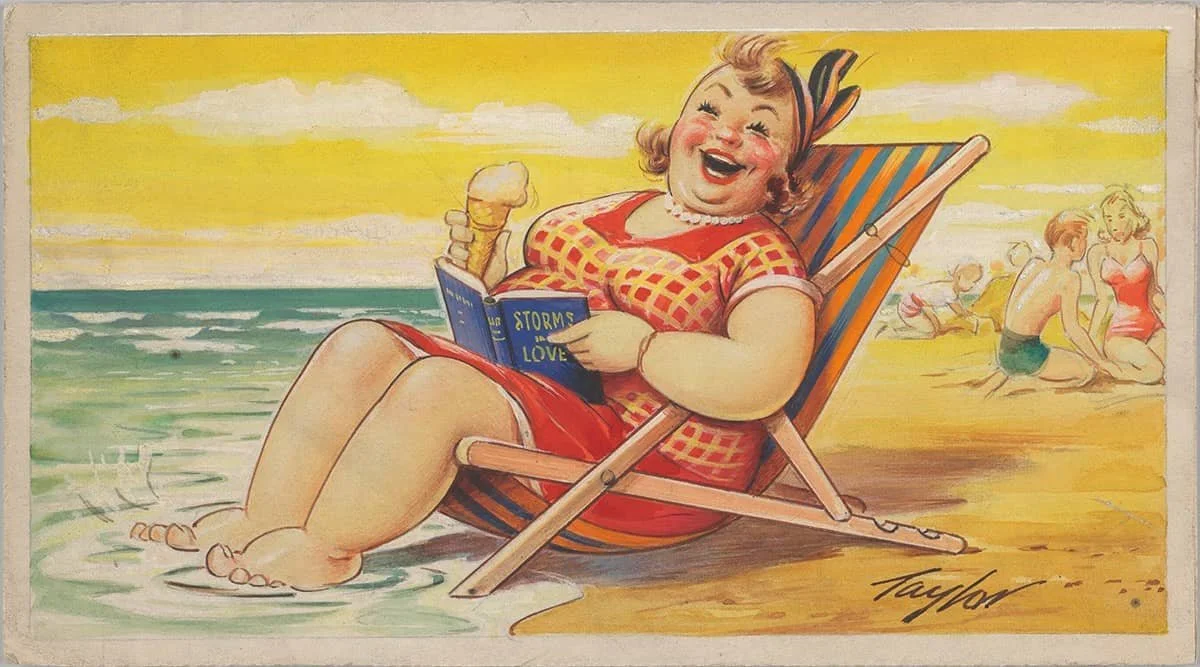
Courtesy The Postal Museum
The advent of mass telephone ownership replaced postcards for quick messaging, but they remained very popular for the quintessential British seaside holiday, featuring images of donkeys on beaches, piers, bandstands, and deckchairs.
Sending a card to family and friends was a cherished ritual, often accompanied by the familiar phrase, ‘wish you were here,’ even on rainy days. The British postcard captures iconic seaside scenes.
Given the popularity of Morecambe and Heysham in the mill towns of Yorkshire, it’s no surprise that Matthews of Bradford (and to a lesser extent Lilywhite of Brighouse, Halifax) became the largest producer of cards covering the resorts of the Northwest during the interwar years.
A quick search on eBay or collector websites reveals numerous examples published by the company of Morecambe and Heysham from the 1920s and 1930s, including Sunderland Point cards. Each card bears the mark ‘Matthews Bradford’, in various fonts, even when showing the same photograph, often with an added production code number.
The most well-known is this set from the 1920s. Here is the ‘multi-view’ card displaying eight images of the Point
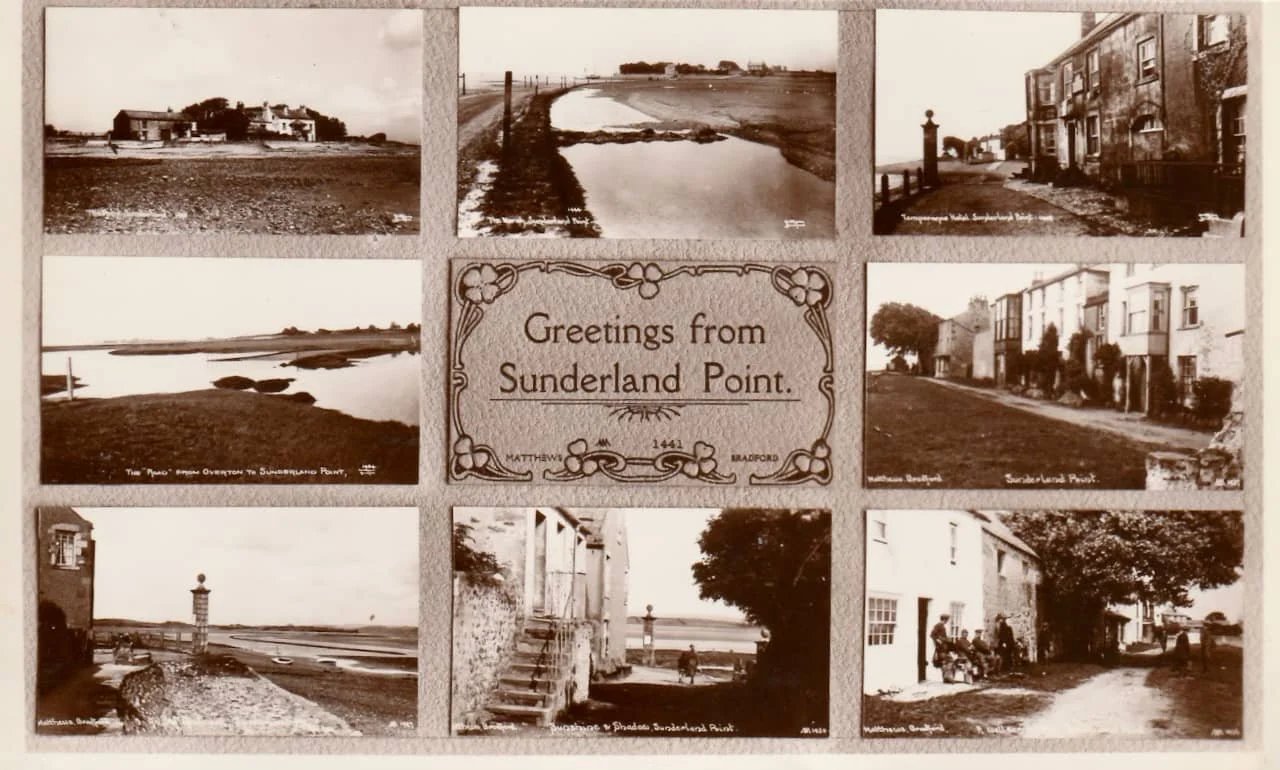
Website collection
This card below, one of the best-known Sunderland point cards, mostly features fisherfolk. The code is clearly visible
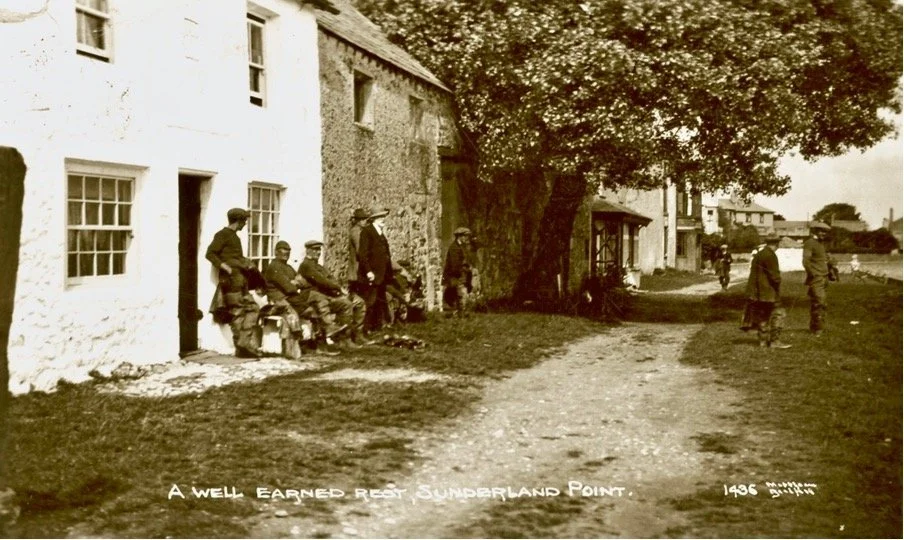
Collection Hugh Cunliffe
A copy of this card, ‘A well-earned rest’, appears in Hugh Cunliffe's history of SP, where he names all those who appear in the photograph.
Here is another well-known 1920s Matthews, Bradford card, a coloured version of village children walking home after school in Overton. The names of the children have been written on the back, and are available on request.
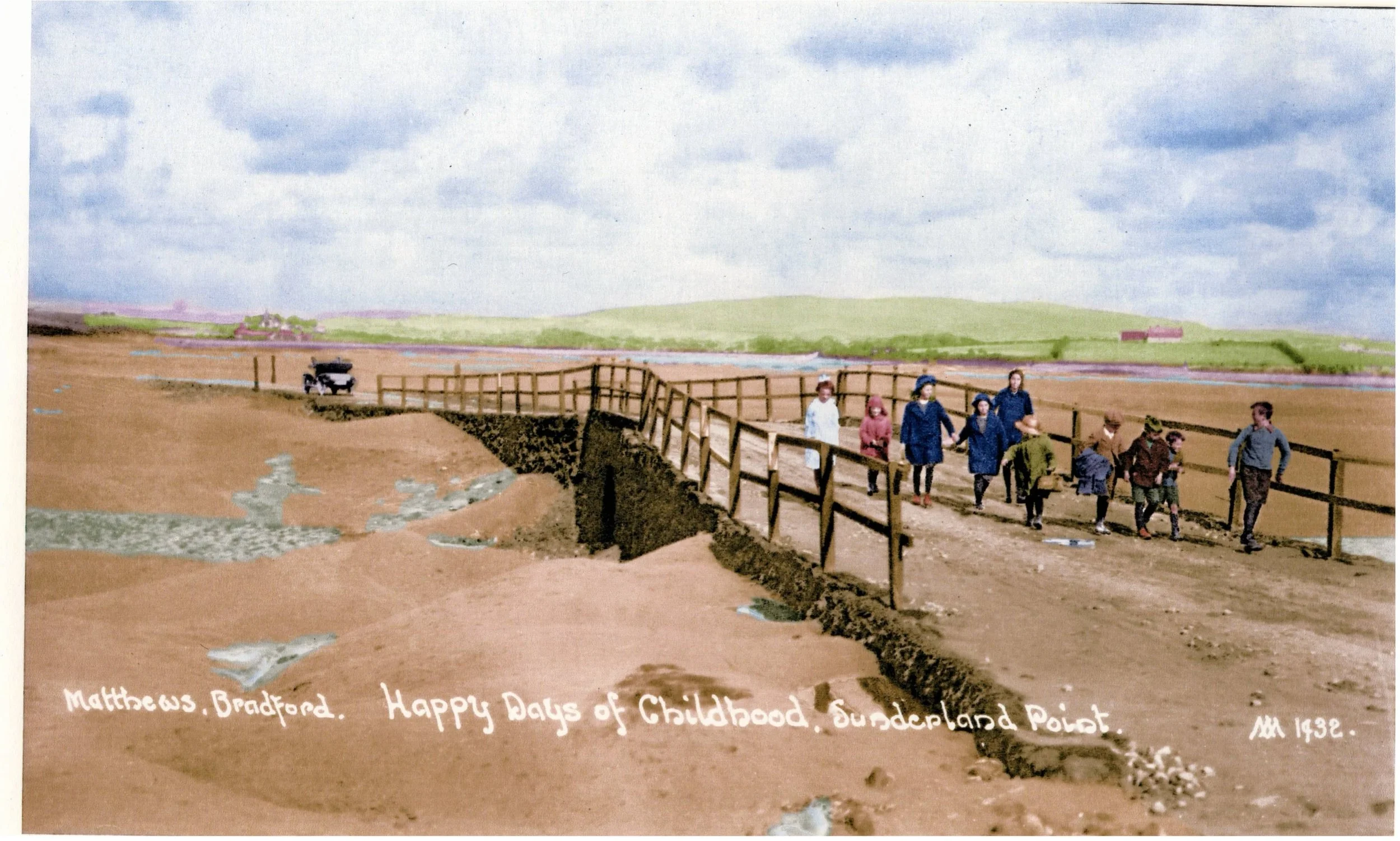
From the collection of Wilton Atkinson
Arthur Palin of Overton
These two originated much closer to home.
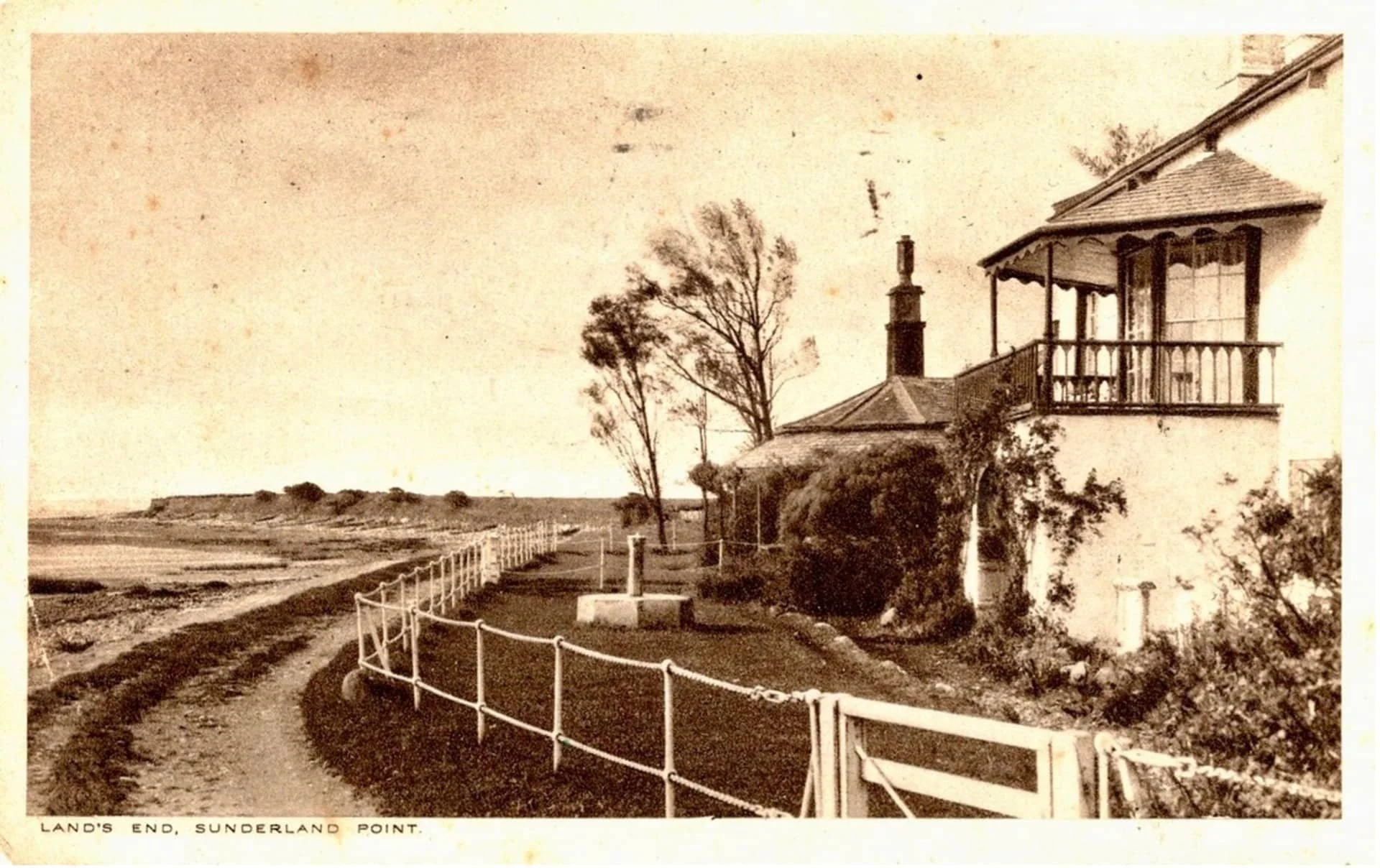
From the Gilchrist family collection
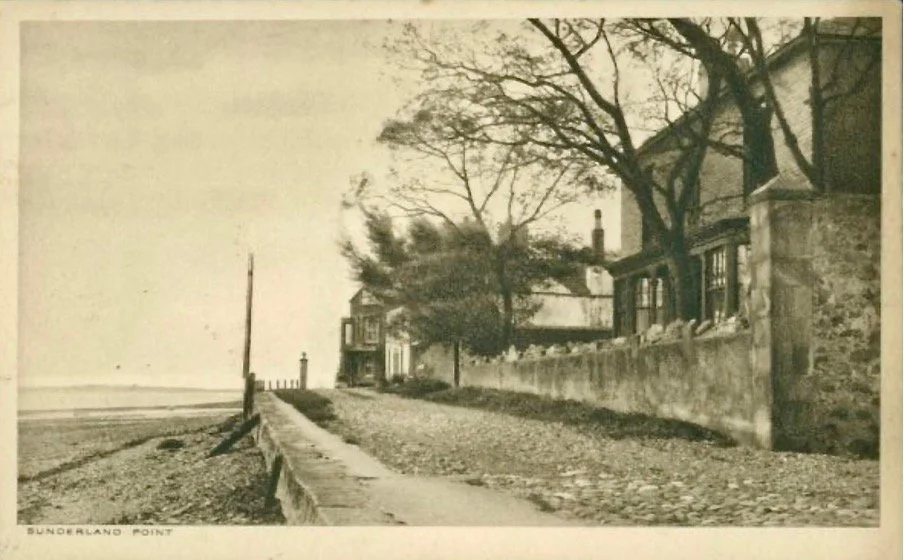
From the collection of Dorothy Calverley
Cards were published locally by Arthur Palin in Overton (we have met Arthur before; he provided a mobile grocery service to the Point, as mentioned in our article on the Village Shop).
Arthur came to Overton in 1923 and rented a shop owned by his sister Annie. A sub-post office was later established in the early 1930s. In addition to making their own ice cream, they created postcards to sell in the shop – including this splendid postcard of the shop itself.

From the collection of Jackie Parkinson-Winter Brown
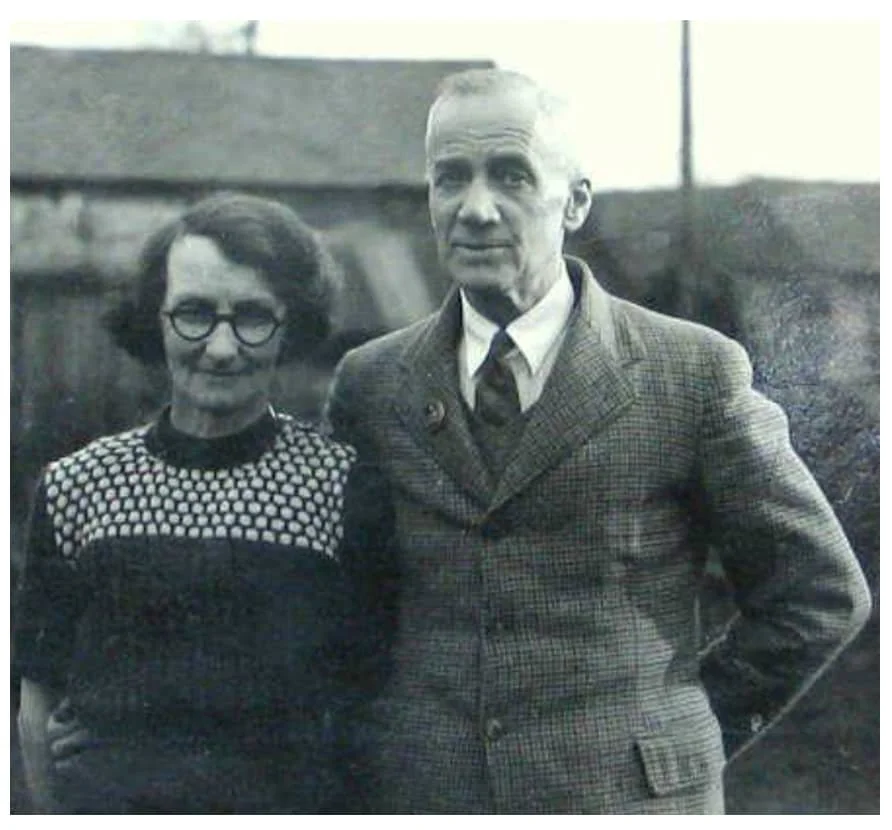
Here is Arthur with his wife, Lillian, in the Garden behind the stores, from the collection of Jackie Parkinson-Winter Brown.
The long life of a postcard photograph
The majority of SP postcards that survive today were published during the interwar years, and it's something of a surprise to see the same photograph being used repeatedly.
Many of these Overton and Matthews, Bradford postcards remained in general circulation until well after the Second World War. Perhaps this explains why so few cards date back to the 1950s, 1960s, even though British Holidays reached their peak in popularity during this period.
The gallery has a few postcards from the 50s and 60s; this is perhaps the best – and, at last, it’s in colour!
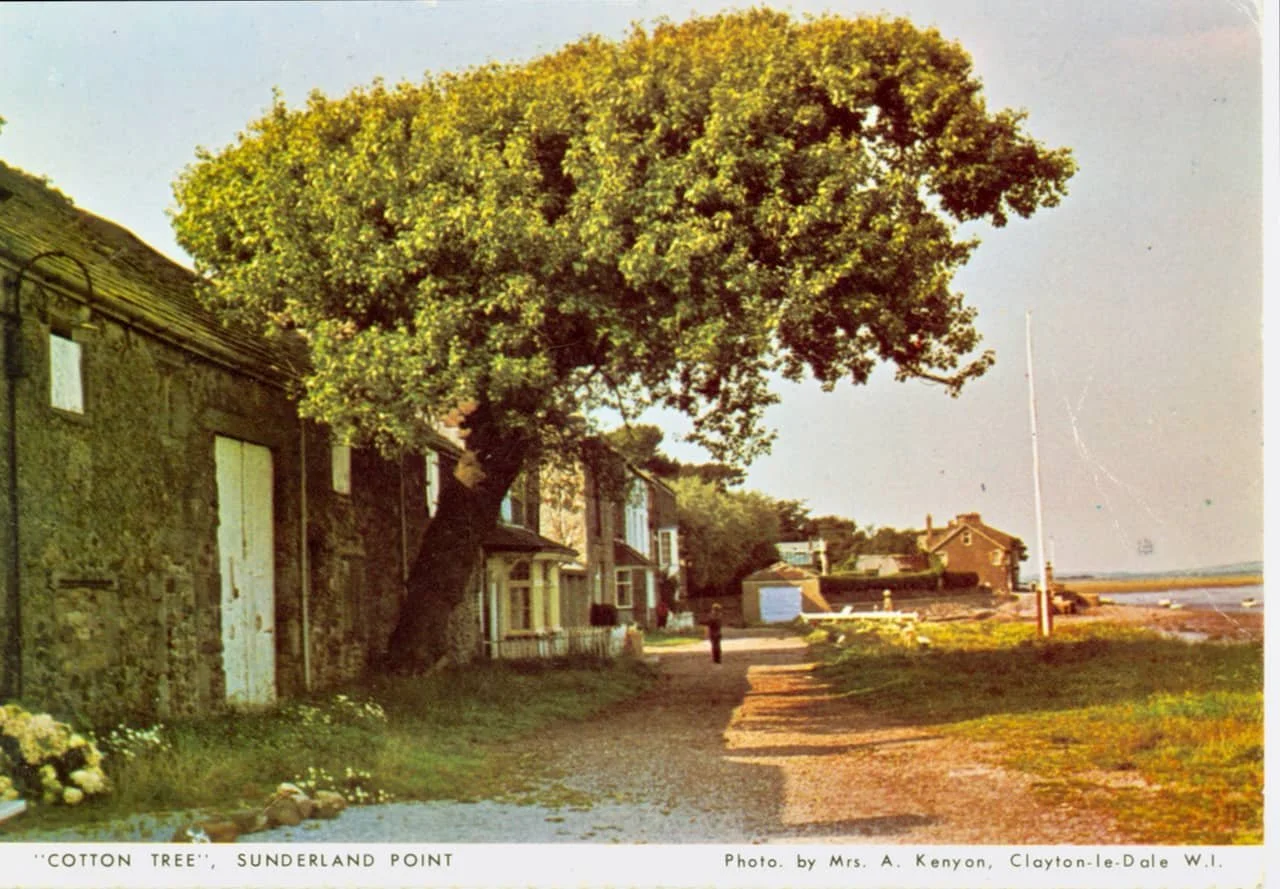
The Cotton Tree 1960s: From the collection of Lynne Levey
The Value of Postcards
Postcards are fascinating and collectable, offering a glimpse of place and social history. Postcards of Sunderland Point, even the oldest ones, hold little monetary value. They are traded among collectors for just a few pounds. The most meaningful to us are those sent by residents or sent to inhabitants of the Point. They evoke nostalgic and sometimes sentimental memories.
Village postcards of social value
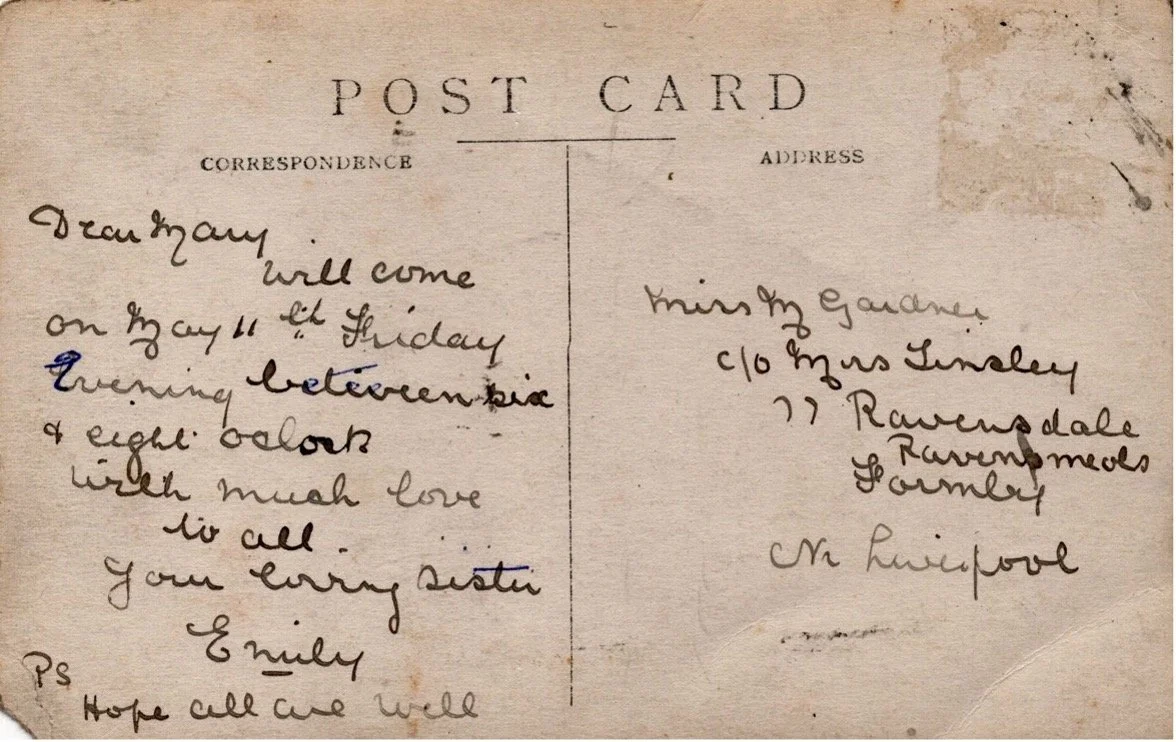
Some examples: this is the earliest dated to World War I (1914-1918). Emily Gardner, who was living at the large house (number 9), has scribbled a quick note to her sister Mary Ann letting her know she will be arriving between 6 and 8 pm. Mary is living in Formby with their Aunt Isabelle (Bella) as a companion and household help.
In later life, both sisters would return to live at SP. Mary Ann, known across the entire village as Auntie Polly, lived in the Summer House at the top of the Lane. Emily, who married ex-soldier Charlie Walker, also lived in the Lane, at number 3
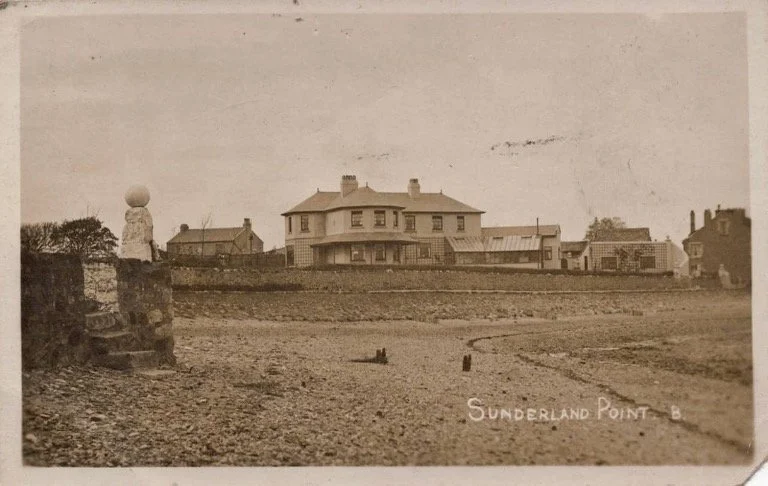
Postcard from the collection of Wilton Atkinson
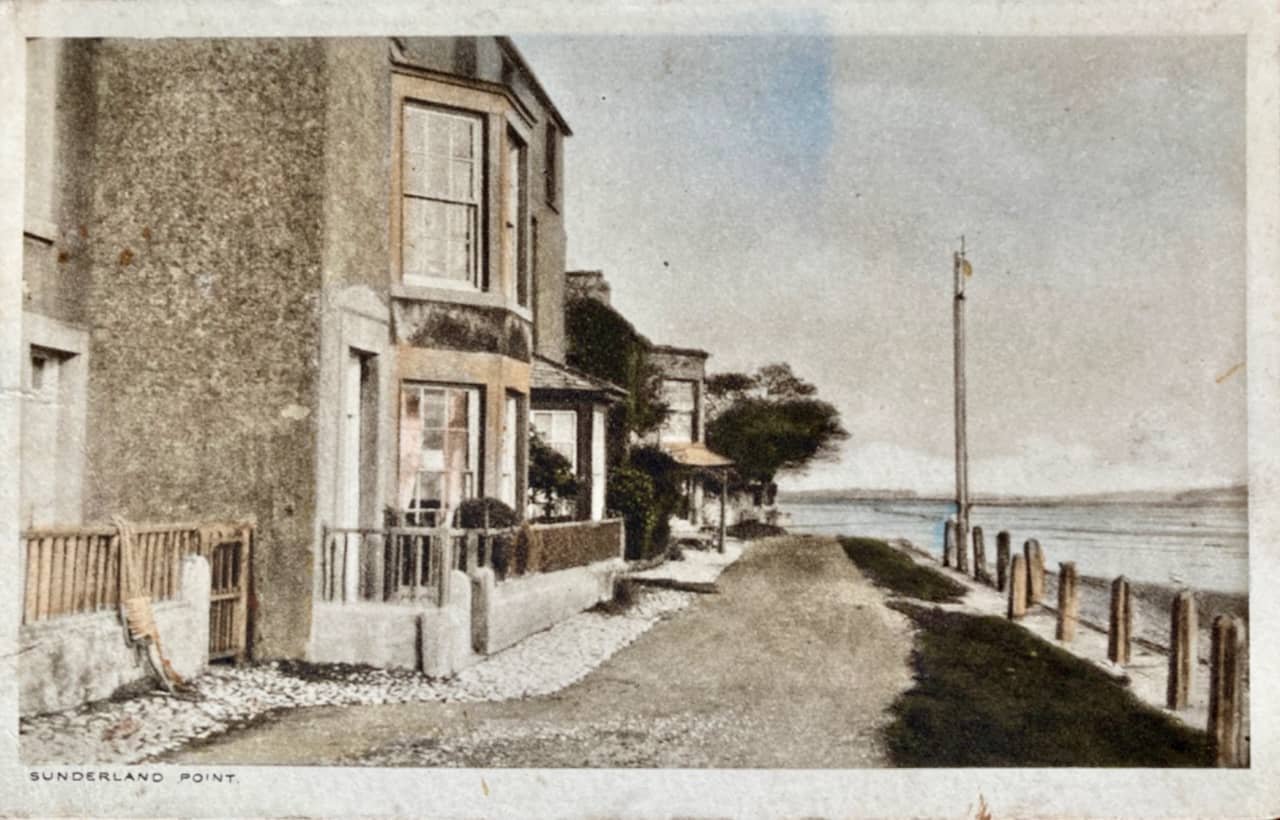
Here is another of Arthur Palin’s cards
Website collection
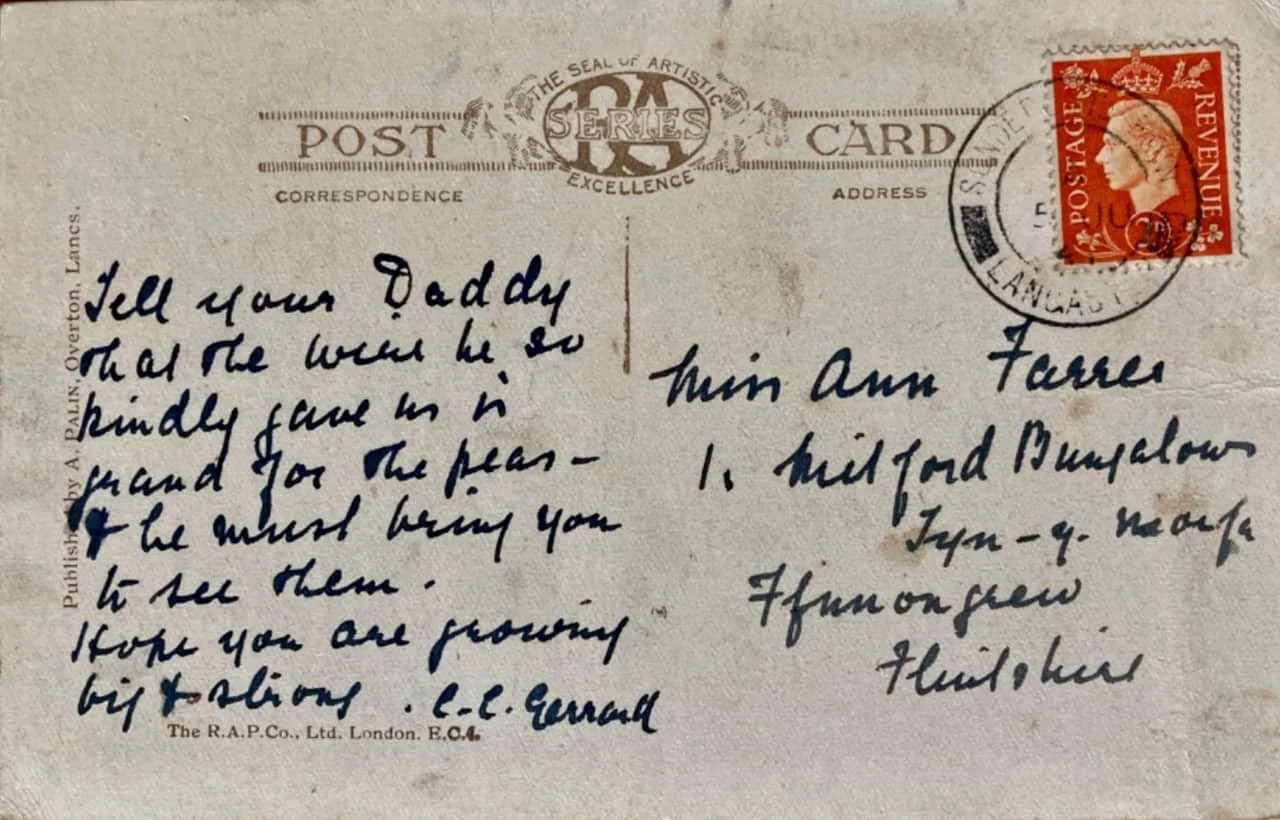
This has been sent by Clara Gerrard, who, with her sister Ada, owned number 8 – seen in the photograph – between 1915 and 1942. Later, they lived together in Gravelly (number 2).
Sent to an unknown young person, the words read, ‘Tell your daddy that the wire he so kindly gave us is grand for the peas, and he must bring you to see them. Hope you are growing big and strong.’
It is postmarked ‘Sunderland Point, Lancaster’, almost certainly stamped and sent at the newly established sub-post office run by Mrs Bertha Cuthill at number 13.
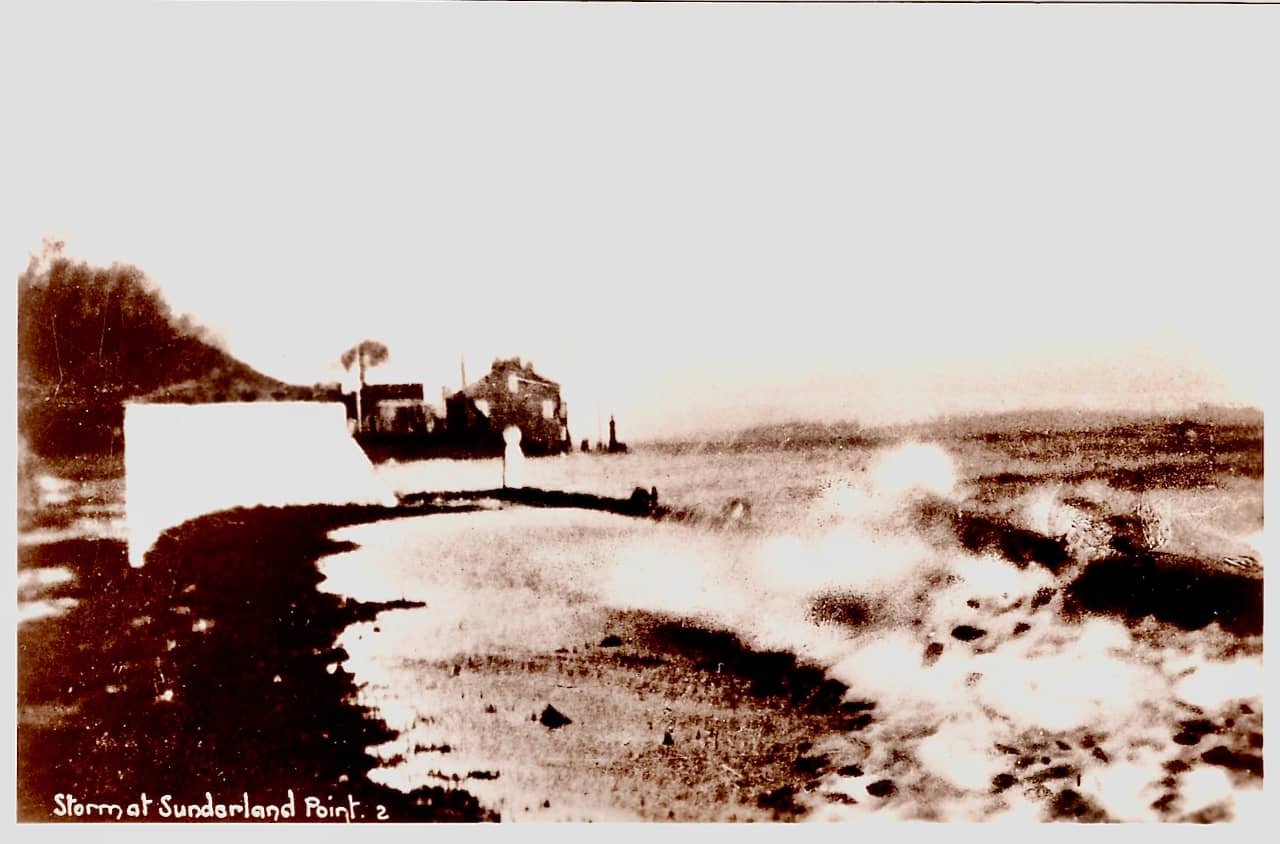
This next one has been written by fisherman Bert Smith while he was living in Multum in Parvo (‘much in little’), the small infill house between numbers 14 and 16.
He has sent the card to a Mr Fogg, perhaps a visitor, to prove that big tides really do reach The Greens on Second Terrace.
Collection Dorothy Calverley
Bert writes:
Dear Mr Fogg, many thanks and best wishes to you both. I think you asked did we ever get the tide over on the green. Well, this proves that it does – just in front of our Cott(age). I shall be pleased to see you again soon. Kind Regards, Bert Smith.
Lastly, on a more personal note
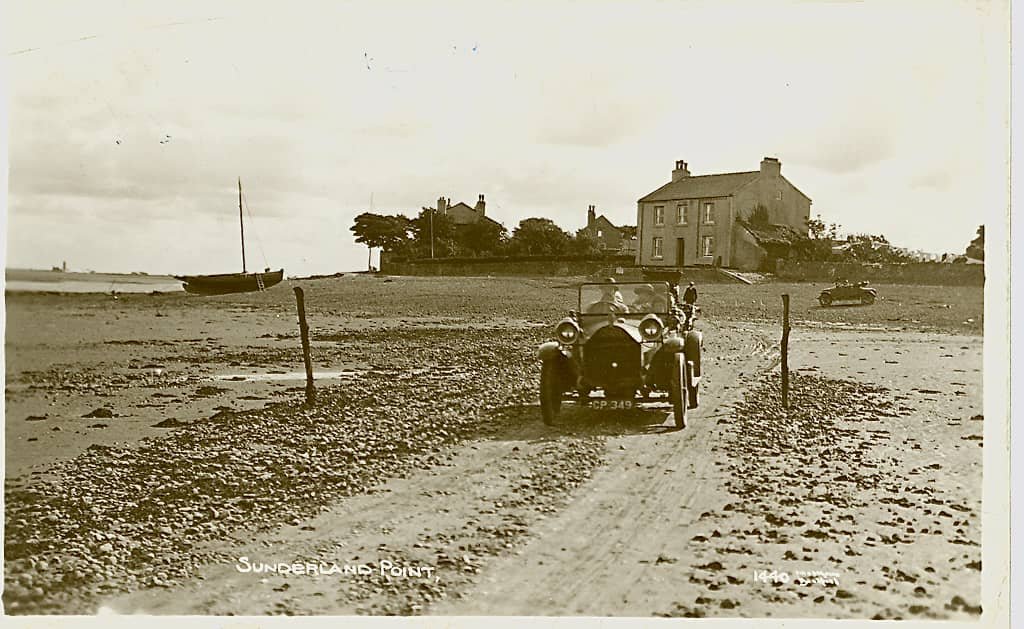
Sunderland Point postcard c1920s: Courtesy Red Rose collection, Lancashire County Council.
(A day trip from Halifax? It’s just possible to make out the car number plate, CP 349. From this, we know it was first registered in Halifax, Yorkshire, in 1921 and last registered in 1926, with the Bull Fold Garage Ltd, Brighouse, Yorkshire. The car is a Hupmobile, made in Detroit in the early 1920s.)
This copy of the postcard, found in the Red Rose collection, shows it was posted in 1932 to Mrs and Miss Pullan of Bolton-le-Sands. The kind Library staff located the original, which confirmed that the sender was Mary Morris (nee Pullan), on holiday at the Point with her husband, David, and family. She sent at least three cards to her mother and sister that week - keeping close touch as their father and husband James Pullan had recently died. Mary was my grandmother.
Decline
Although buying a postcard, especially on a ‘foreign holiday’, and sending it home to mum and dad still exists, even if it arrives after the sender returns home.
The affordability of postcards suffered in 1968 with the introduction of the two-tier system, 1st and 2nd class postage, eliminating the previously cheaper rate for postcards.
The Last Postcards
New cards featuring Sunderland Point can be found, but these are mostly vintage photographs sold in a gift shop on a visit to a museum.
The last cards made for sale we can find of the Point are these two, created by Hugh Cunliffe in the 1970s using his own photographs.
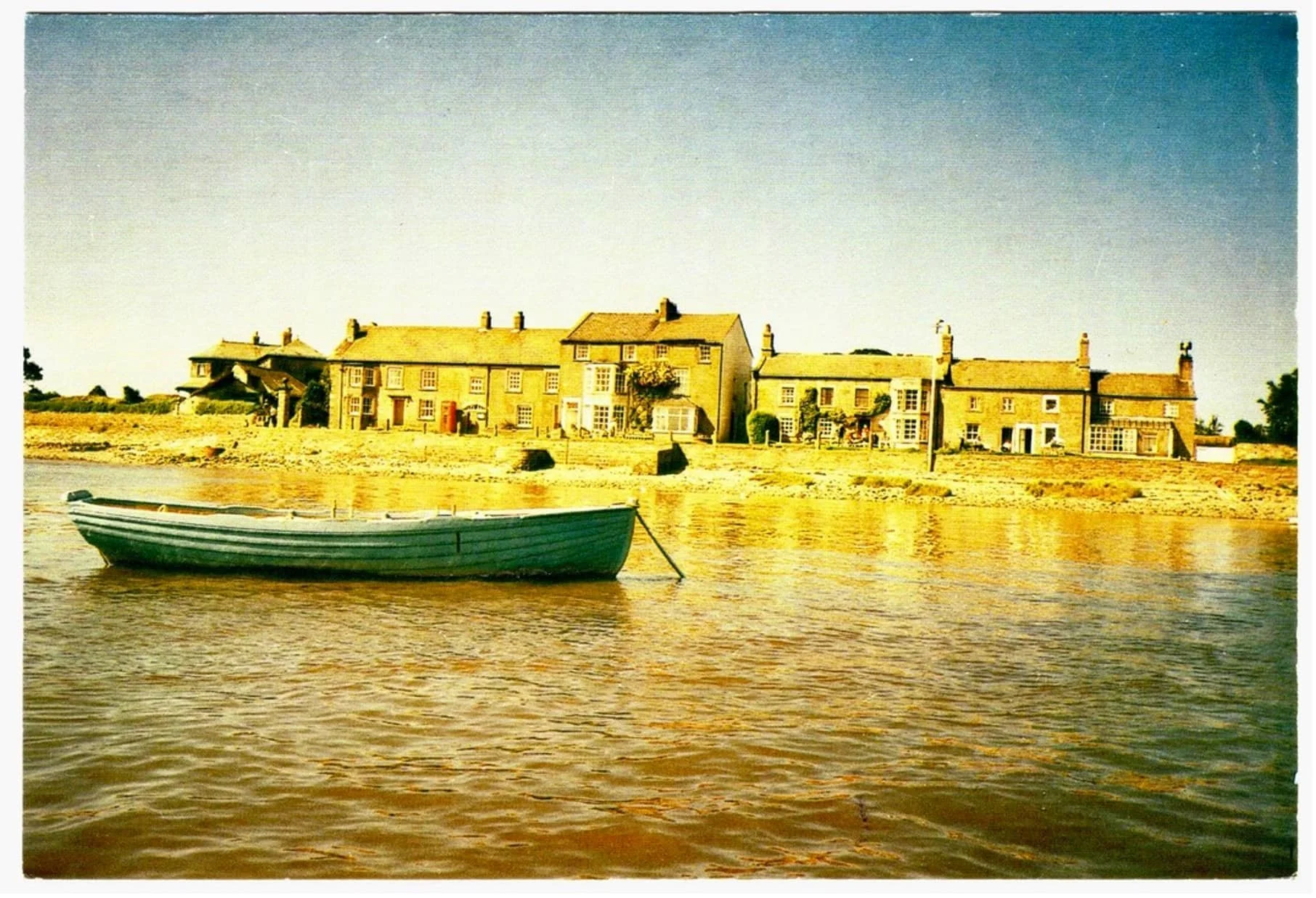
Website Collection
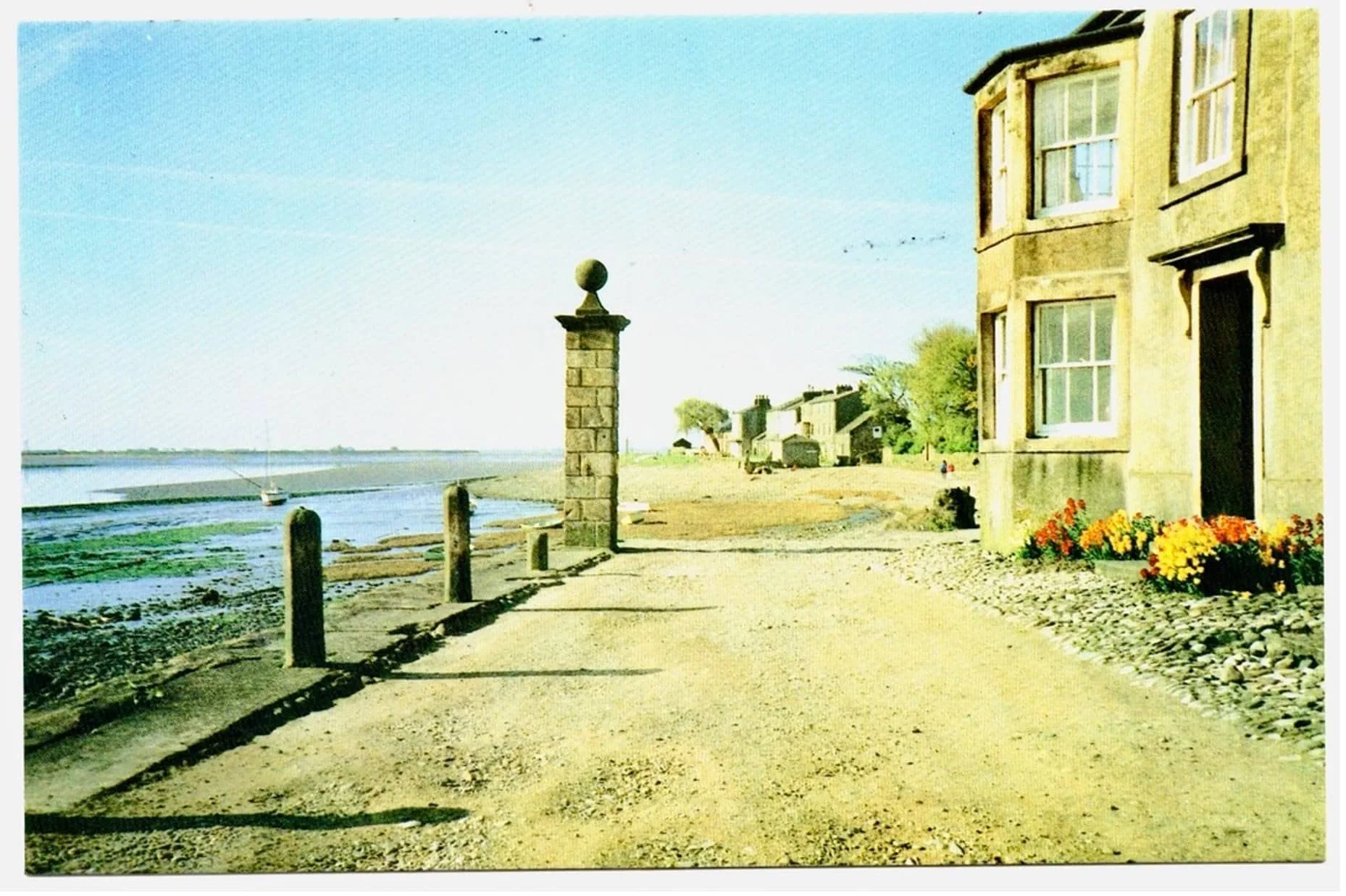
Website Collection
The Gallery
Please follow this link to the gallery. The collection is far from complete, and many more postcards must exist. If you have any cards of the village you would like to copy and send to us, we would be very grateful. Especially A, and C.
With thanks to
The Red Rose collection, Lancashire Archives, Lancaster City Museums, the Gilchrist family, Dorothy Calverley, Jackie Parkinson-Winter Brown, Beth Hampson, Lynne Levey, Alan Smith, and Robert Hall.